Hotel technology spending has undergone a structural shift. In 2022, just 23% of a typical hotel’s technology budget went to new software. By 2024, that figure hit 69%. Meanwhile, 78% of hotels planned to increase IT spending by 3% or more, and 81% of hoteliers implemented or planned at least one major technology project. AI adoption spending in hospitality is projected to grow 60% annually through 2033.
For IoT and connected room system suppliers, this is not a trend. It is a permanent reallocation of hotel capital expenditure toward technology — and the market is still in early innings. As the 2025 hotel supply industry report makes clear, technology integration is one of the five forces reshaping the entire supply chain.
This guide breaks down the smart hotel technology landscape, what hotel buyers are actually purchasing, integration requirements that make or break deals, and how tech suppliers from adjacent industries can enter hospitality.
The Smart Hotel Technology Stack
A “smart hotel room” is not a single product. It is an integrated system of hardware, software, and connectivity that spans multiple functional categories. Understanding the full stack helps suppliers identify where their products fit and what adjacent capabilities they need to integrate with.
Core Technology Categories
| Category | Products | Hotel Buyer Role | Market Maturity | Typical Per-Room Cost |
|---|---|---|---|---|
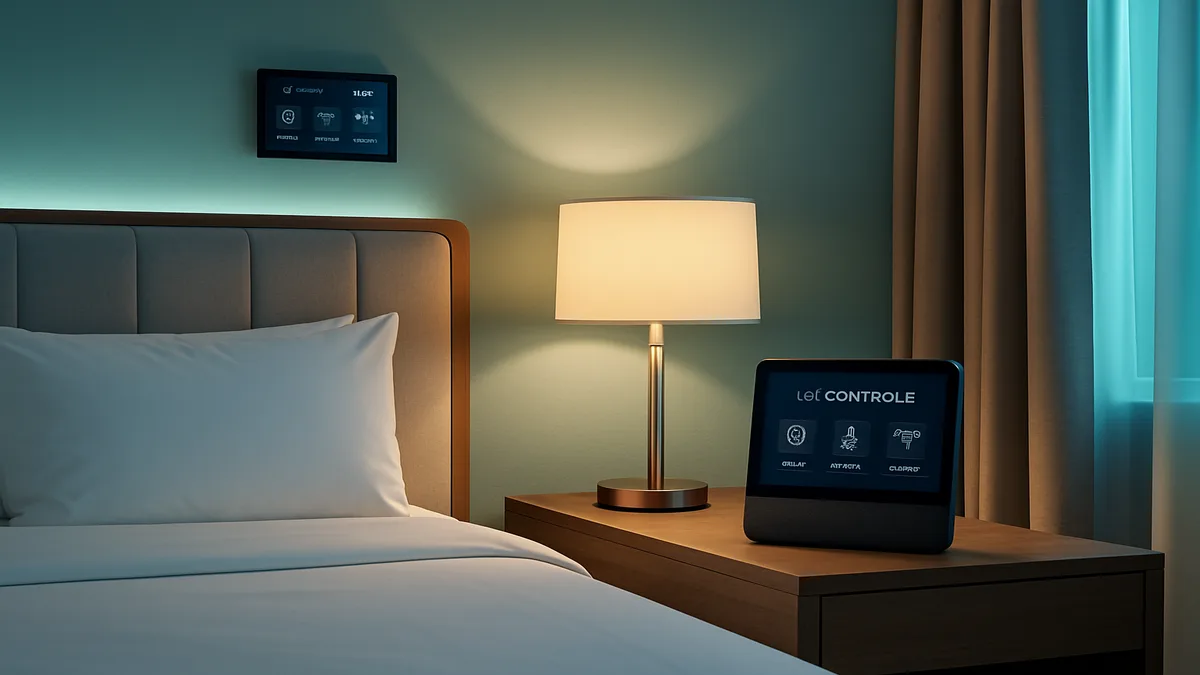
| In-Room Tablets / Guest Experience | Interactive tablets, digital compendiums, service ordering | Guest Services, IT Director | Growing rapidly | $200 - $600 |
| Voice Assistants | Amazon Alexa for Hospitality, Google Nest Hub, custom solutions | IT Director, Brand Innovation | Early adoption | $50 - $200 |
| IoT Thermostats / HVAC Control | Smart thermostats, occupancy-based climate control, energy management | Engineering, Sustainability | Mainstream | $150 - $400 |
| Keyless Entry / Smart Locks | Mobile key, RFID, Bluetooth, NFC locks | Security, IT, Operations | Mainstream | $300 - $800 |
| Smart TVs / Casting | Hospitality TVs with casting, streaming apps, content management | IT Director, Guest Services | Mainstream | $400 - $1,200 |
| Lighting Control | Automated lighting, scene setting, occupancy sensors | Engineering, Design | Growing | $100 - $500 |
| Energy Management Systems | Building-wide energy monitoring, room-level optimization | Engineering, Finance | Growing rapidly | $50 - $200 (per room, system-wide) |
| Guest Experience Platforms | Mobile apps, chatbots, personalization engines, CRM integration | Marketing, Guest Services, IT | Growing rapidly | $5 - $25/room/month (SaaS) |
How These Systems Interconnect
The single greatest challenge in smart hotel technology is integration. Hotels do not buy technology categories in isolation — they need systems that talk to each other and to the Property Management System (PMS) that runs the hotel.
A typical connected room data flow:
Guest Mobile App / Check-in Kiosk
        |
   PMS (Opera, Mews, Cloudbeds, etc.)
        |
   +---------+---------+---------+
   |         |         |         |
Smart Lock  HVAC    Lighting   TV/Casting
   |         |         |         |
   +---------+---------+---------+
        |
   Room Status / Occupancy Detection
        |
   Energy Management Dashboard
When a guest checks in via mobile app, the PMS triggers the smart lock to activate their mobile key, sets the thermostat to their preferred temperature (stored from previous stays), adjusts lighting to a welcome scene, and queues a personalized greeting on the TV. When the guest leaves the room, occupancy sensors detect the empty room and reset HVAC/lighting to energy-saving mode.
This orchestration is the value proposition. Any single device in isolation is a commodity. The integrated experience is what hotels pay a premium for.
Market Sizing and Growth Drivers
IoT in Hospitality: By the Numbers
| Metric | Data Point | Source Context |
|---|---|---|
| Energy reduction from IoT | 20% - 45% | Industry-wide range; smart HVAC alone delivers up to 30% reduction |
| Hotels with in-room technology | 86% | Of hotel operators have introduced some form |
| Hotels planning digital guest apps | 74% | Planning rollout in near term |
| Mobile key adoption projection | 70%+ | Projected adoption rate by 2025 |
| Guest return rate increase (AI personalization) | 48% higher | For guests experiencing AI-personalized touches |
| AI in supply chain market (2024) | $7.3 billion | Growing to $63.8B by 2030 at 42.7% CAGR |
| Hotel tech budget shift to new software | 23% (2022) to 69% (2024) | Massive reallocation of capital toward technology |
What Is Driving Adoption
1. Labor shortage compensation. With 79% of hoteliers reporting staff shortages and housekeeping as the number-one critical staffing need, technology that reduces labor requirements per room is no longer a luxury — it is an operational necessity. Mobile check-in eliminates front desk bottlenecks. In-room tablets replace concierge staffing. Automated energy management reduces engineering rounds.
2. Guest expectations. Post-pandemic travelers expect digital experiences as a baseline. Contactless check-in, mobile keys, and streaming capability on in-room TVs are now expected, not differentiating. Hotels without these capabilities face negative reviews and lower repeat bookings.
3. Energy cost reduction. With energy representing 3-6% of hotel operating costs, IoT-based energy management delivers ROI in 12-24 months. Smart HVAC alone can reduce energy costs by up to 30%. For a 200-room hotel spending $500,000 annually on energy, that is $150,000 in annual savings — enough to fund the entire smart room technology rollout.
4. Brand mandates. Hilton’s Connected Room technology is expanding annually across its portfolio. Marriott, IHG, and Hyatt all have brand-standard technology requirements that are updated on 3-5 year cycles. When a brand mandates a technology upgrade, every property in the system must comply — creating massive, predictable purchase orders that often coincide with the broader hotel renovation super-cycle.
5. Sustainability reporting. Hotel chains have aggressive sustainability targets. Marriott targets net-zero by 2050. Hilton targets 75% carbon reduction by 2030. IoT-based energy management, water monitoring, and waste tracking provide both the operational savings and the reporting data needed to meet these commitments.
What Hotel Buyers Actually Evaluate
Tech suppliers from adjacent industries (residential IoT, commercial building automation, consumer electronics) often struggle to sell into hospitality because they misunderstand what hotel buyers care about. The evaluation criteria are fundamentally different from residential or commercial office markets.
Hotel Technology Evaluation Matrix
| Criteria | Weight | What Hotels Want | Common Supplier Mistake |
|---|---|---|---|
| PMS integration | Critical | Certified integration with Oracle Opera, Mews, Cloudbeds, Stayntouch, or the specific PMS the hotel uses | Assuming generic API = hotel-ready |
| Brand approval | Critical | Listed on the brand’s approved technology vendor list | Approaching individual properties without brand approval |
| Network architecture | High | Works on isolated IoT VLAN; does not require guest Wi-Fi bandwidth; supports on-premise or cloud deployment | Designing for consumer-grade networks |
| Scalability | High | Single dashboard managing 100-5,000+ rooms across multiple properties | Selling single-property solutions to chain buyers |
| Guest experience | High | Invisible technology. Guest never “fights” the system. No app download required (or minimal friction) | Over-engineering the guest interaction |
| Support / SLA | High | 24/7 support with 4-hour response time. On-site support within 24 hours. 99.9% uptime SLA | Offering business-hours-only support |
| Total cost of ownership | Medium | 5-year TCO including hardware, licensing, installation, maintenance, and replacement | Quoting hardware cost only; hiding SaaS fees |
| Data privacy / security | Medium-High | GDPR compliance, PCI DSS for payment-adjacent systems, SOC 2 Type II certification | Treating hospitality data casually |
| Installation complexity | Medium | Can be installed in occupied hotel with minimal disruption; per-room install under 2 hours | Requiring full-floor shutdowns for installation |
Stop chasing hotels manually. InnLead.ai’s 12 AI agents scan renovation signals, identify procurement contacts, and book meetings with hotel buyers — automatically. Get Early Access
Entering the Hospitality Market: A Technology Supplier’s Roadmap
Step 1: Identify Your Integration Requirements
Before you approach a single hotel, answer these questions:
- Which PMS systems does your product integrate with? Oracle Opera has the largest market share in full-service hotels. Cloudbeds and Mews are gaining share in independent and lifestyle segments. If you do not have a certified integration with at least one major PMS, you are not ready.
- What protocol does your hardware use? Hotels standardize on specific IoT protocols. BACnet and Modbus are common for building automation. Zigbee, Z-Wave, and Thread are used for in-room devices. Wi-Fi and Bluetooth for guest-facing applications.
- Can your system operate on an isolated network? Hotel IT architecture segments guest Wi-Fi, operational systems, PMS, and IoT into separate VLANs for security. Your product must work within this architecture.
Step 2: Get Brand Approved
Major hotel brands maintain technology vendor programs:
| Brand | Technology Program | Application Process |
|---|---|---|
| Marriott | Marriott Approved Technology Vendors | Formal application, product testing, brand standards review |
| Hilton | Hilton Approved Connected Room Partners | Integration testing with Connected Room platform |
| IHG | IHG Technology Vendor Program | Product evaluation, pilot program, system-wide approval |
| Hyatt | Hyatt Approved Technology Partners | Application, pilot, brand standards compliance |
| Wyndham | Wyndham Technology Services | Vendor application and product review |
Brand approval typically takes 6-18 months and may require a pilot installation at 1-3 properties before system-wide approval. Budget $50,000-$150,000 for the pilot process (discounted hardware, dedicated support, travel).
Step 3: Build Your Hospitality Go-to-Market
| Channel | Best For | Typical Timeline |
|---|---|---|
| Direct to brand/chain | System-wide rollouts of 500+ properties | 12 - 24 months from first meeting to PO |
| Direct to management company | Portfolio deployments of 20-200 properties | 6 - 12 months |
| Direct to independent hotel | Single-property installations | 2 - 6 months |
| Through systems integrator | Renovation projects needing multi-vendor coordination | 3 - 9 months (piggybacking on renovation timeline) |
| Through procurement platform | Avendra, Birch Street Systems networks (see platform comparison) | 6 - 12 months for onboarding, then ongoing |
Step 4: Price for Hospitality
Hotel technology pricing models differ significantly from consumer or commercial:
Hardware + SaaS (most common): Discounted hardware cost ($100-$500 per room) plus monthly SaaS fee ($5-$25 per room) for software, updates, and cloud management. Hotels prefer this because it reduces upfront capital expenditure and spreads cost over the PMS contract term (typically 3-5 years).
Hardware-only with maintenance contract: Full hardware cost upfront ($300-$800 per room) plus annual maintenance fee (10-15% of hardware cost). Common for simpler systems like locks and thermostats.
Full managed service: Supplier owns the hardware, hotel pays a monthly service fee ($15-$50 per room). Emerging model for comprehensive connected room platforms. Attractive to hotels because it transfers technology obsolescence risk to the supplier.
Step 5: Navigate the Renovation Cycle
The largest technology purchasing events coincide with hotel renovations. When a hotel undergoes a PIP-driven renovation, the technology budget is typically 15-25% of the total project cost. With guest room renovations running $8,000-$25,000 per room, that translates to $1,200-$6,250 per room in technology spend.
The global hotel pipeline hit 15,820 projects / 2.4M rooms in Q4 2024. Even if only 30-40% of those projects include significant technology upgrades, that represents 720,000-960,000 rooms being outfitted with new technology annually.
Category Deep Dives
Smart Locks and Keyless Entry
Mobile key adoption is projected to exceed 70% by 2025. Hilton has rolled out Digital Key Share across its portfolio. Marriott offers mobile key at thousands of properties. The technology is standardized enough that hotels now evaluate locks primarily on:
- Integration depth with their PMS
- Backup access methods (physical key card, PIN, staff override)
- Battery life and maintenance requirements
- BLE range and reliability through hotel-grade doors
- Aesthetic compatibility with brand design standards
Price sensitivity: Hotels will pay $300-$800 per lock for a proven system with strong PMS integration. They will not pay $1,000+ unless it includes biometric features demanded by the luxury segment.
Energy Management and IoT Thermostats
The ROI case is the strongest in this category. IoT reduces hotel energy use by 20-45%, with smart HVAC alone delivering up to 30% cost reduction. For a 300-room full-service hotel:
| Metric | Before IoT | After IoT | Annual Savings |
|---|---|---|---|
| Annual energy cost | $750,000 | $525,000 - $600,000 | $150,000 - $225,000 |
| System cost (one-time) | — | $75,000 - $150,000 | — |
| Monthly SaaS | — | $1,500 - $3,000 | — |
| Payback period | — | — | 6 - 12 months |
These numbers make energy management the easiest technology sale in hospitality. The buyer is typically the VP of Engineering or Chief Sustainability Officer, and the decision is driven by P&L impact rather than guest experience.
In-Room Tablets and Guest Experience Platforms
This category is the fastest-growing and the most fragmented. The core value proposition: replace printed compendiums, room service menus, and concierge interactions with a single device that also enables upselling, service requests, and guest feedback.
Hotels report 15-30% increases in room service and spa bookings when in-room tablets are deployed with smart upselling algorithms. At $200-$600 per room for hardware and $5-$15 per room per month for software, the ROI comes from incremental revenue rather than cost savings.
Common Pitfalls for Technology Suppliers Entering Hospitality
1. Underestimating the sales cycle. Enterprise hotel technology sales take 6-24 months. The buying committee includes IT, operations, ownership/asset management, and brand representatives. Do not plan for consumer-cycle revenue expectations.
2. Ignoring the brand layer. Selling directly to a franchised Marriott without Marriott brand approval wastes everyone’s time. The property cannot implement unapproved technology without risking franchise compliance issues.
3. Building for new construction only. The majority of hotel technology sales occur during renovations, not new builds. Your installation process must work in occupied hotels with minimal room downtime (ideally under 2 hours per room).
4. Neglecting the management company. In the hotel industry, the property owner, the management company, and the brand are often three separate entities. The management company (Aimbridge, Highgate, Crescent, etc.) typically makes technology decisions across their managed portfolio. One relationship with a management company operating 200 hotels can generate more revenue than 200 individual hotel relationships.
5. Treating data as an afterthought. Hotels are fiercely protective of guest data. Any technology that collects, stores, or transmits guest information must comply with GDPR, CCPA, and brand-specific data policies. A data breach at a hotel can trigger franchise termination. Your security posture is a sales differentiator.
The Path Forward
The hotel technology market is in a structural growth phase driven by labor constraints, guest expectations, sustainability mandates, and brand competition. Technology budgets have nearly tripled their allocation to new software in two years. The construction pipeline is at an all-time record. And most hotels are still in the early stages of smart room deployment.
For technology suppliers, the opportunity is clear. The challenge is not demand — it is access. Identifying which hotels are upgrading, when their renovation window opens, who controls the technology budget, and how to reach them before competitors do. In a market of 15,820 active projects across dozens of countries and hundreds of brands, manual prospecting cannot scale — which is exactly why AI-powered procurement tools are becoming essential on both sides of the buyer-supplier relationship.
The suppliers who will win this market are the ones who combine strong products with systematic market intelligence — knowing not just that hotels are buying, but which hotel, which category, which quarter, and which decision-maker holds the budget. Discover how InnLead.ai delivers that intelligence.
Use these related guides to keep moving through the same procurement, sales, or market research thread.
Skip the Manual Work
InnLead.ai's 12 AI agents find hotels buying your products, identify procurement contacts, and book meetings -- automatically.
Get Early Access