The hotel supply industry runs on relationships. For decades, suppliers have built their sales pipelines the same way: exhibit at HD Expo, work the floor at BDNY, collect business cards at HITEC, and cold-call general managers between shows. Layer in a few distributor partnerships and some Google Ads, and you have the standard hotel supplier go-to-market playbook.
It works. Until it does not scale.
The global hotel construction pipeline hit 15,820 projects representing 2.4 million rooms in Q4 2024 — an all-time record. The U.S. alone has 6,378 projects in various stages of development. There are 303,330 rooms in active conversion or renovation. The PIP backlog is estimated at $12-15 billion. And 79% of hoteliers report staff shortages, which means procurement decisions are being made faster, with fewer meetings, by overwhelmed teams who do not have time for a discovery call.
In this environment, traditional sales methods leave money on the table. Not because they are bad, but because they are slow, imprecise, and unscalable. AI-powered lead generation solves all three problems. It is one of 12 proven B2B lead generation strategies for hotel suppliers — and arguably the one with the highest leverage in 2025 and beyond.
The Traditional Hotel Supply Sales Model
Before examining what AI changes, it is worth understanding what most hotel suppliers are doing today — and where the gaps are.
Common Sales Channels for Hotel Suppliers
| Channel | Cost Per Lead | Close Rate | Time to Revenue | Scalability |
|---|---|---|---|---|
| Trade shows (HD Expo, BDNY, HITEC) | $150 - $500 | 3% - 8% | 6 - 18 months | Low (1-3 shows per year) |
| Cold calling / email outreach | $25 - $75 | 1% - 3% | 3 - 12 months | Medium (limited by sales team size) |
| Distributor / rep network | $50 - $150 (commission-based) | 5% - 12% | 3 - 9 months | Medium (limited by rep capacity) |
| Referrals / word of mouth | $0 - $25 | 15% - 30% | 1 - 6 months | Low (unpredictable volume) |
| B2B marketplaces (Alibaba, Amazon Business) | $10 - $50 | 1% - 5% | 1 - 3 months | Medium (high competition) |
| Inbound marketing (SEO, content) | $30 - $100 | 5% - 10% | 6 - 24 months (build period) | High (scales with content) |
Where Traditional Methods Break Down
1. Timing blindness. A trade show happens in May. A hotel receives its PIP in August. By the time you follow up from the show in September, the buyer has already shortlisted three vendors from their approved vendor list. You never had a chance because you did not know the PIP was issued.
2. Contact accuracy decay. Hotel management turns over at staggering rates. The Director of Procurement you met at BDNY 2023 moved to a different management company six months later. Your CRM is full of contacts who no longer control the budget you are targeting. The hospitality sector has the highest quit rate of any industry — 4% of workers leave monthly.
3. Qualification guesswork. Cold outreach treats every hotel as equally likely to buy. But a hotel in year 2 of a 7-year PIP cycle has zero buying intent for renovation products. A hotel that just changed ownership has maximum buying intent. Without signal intelligence, your sales team wastes 70-80% of their outreach on hotels that are not in a buying window.
4. Geographic constraints. Your sales team covers the Southeast U.S. But a 400-room hotel in Phoenix just filed renovation permits. A management company in Chicago is converting 15 properties to a new brand. A Saudi Arabian mega-project just opened procurement. Without AI scanning these signals globally, you are limited to the markets you can physically reach.
5. Scale ceiling. A top-performing sales rep manages 50-100 active relationships. With 15,820 hotel projects globally, even a 10-person team covers less than 1% of the addressable market. Adding headcount is expensive ($80K-$150K per rep fully loaded) and takes 6-12 months to ramp.
How AI Lead Generation Works for Hotel Suppliers
AI-powered sales tools do not replace the relationship — they accelerate how you find, qualify, and initiate it. The technology stack breaks into five functional layers.
Layer 1: Signal Monitoring
AI systems continuously monitor public and proprietary data sources for hotel buying signals:
| Signal Category | Examples | What It Indicates | Data Sources |
|---|---|---|---|
| Construction / Renovation | Building permits, contractor bids, design firm assignments | Active or imminent renovation; FF&E procurement window opening | Municipal databases, construction platforms, permit filings |
| Ownership Changes | Hotel sale filings, management company transitions, franchise transfers | Likely PIP issuance; new owner evaluates all suppliers | Commercial real estate databases, county records, SEC filings |
| Brand Activity | New franchise agreements, brand conversion filings, brand standard updates | Conversion PIP; system-wide procurement event | Franchise disclosure documents, chain press releases, state filings |
| Financial Indicators | RevPAR trends, occupancy data, CapEx announcements in earnings calls | Investment capacity and renovation likelihood | STR data, public filings, hotel performance platforms |
| Personnel Changes | New GM, new VP of Procurement, new Director of Operations | Decision-maker transition; window for new supplier relationships | LinkedIn, press releases, management company announcements |
The critical insight: none of these signals are hidden. They are all publicly available. But they exist across dozens of databases, in different formats, with different update frequencies. Manually monitoring them across 15,820 projects is physically impossible. AI aggregation and pattern matching turns noise into actionable intelligence.
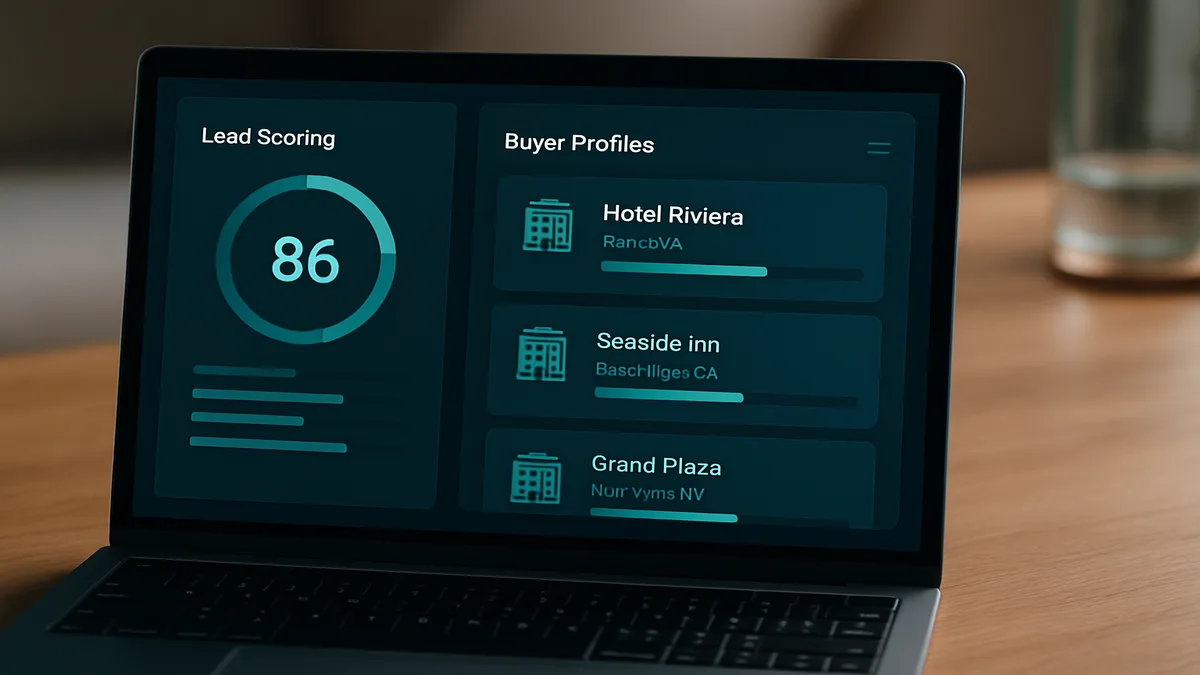
Layer 2: Lead Qualification and Scoring
Not every signal represents a qualified lead. AI scoring models evaluate each signal against multiple criteria:
- Timing alignment: Is the hotel in a procurement window for your product category?
- Budget capacity: Does the hotel’s financial profile support the purchase?
- Decision-maker accessibility: Can we identify and reach the person who controls the budget?
- Competitive landscape: How many other suppliers are already engaged?
- Geographic fit: Is the hotel in a market you can serve?
- Brand compatibility: Does the hotel’s brand standard align with your product specifications?
A scored lead might look like: “Hilton Garden Inn, Dallas, TX — ownership changed 45 days ago — PIP likely issued — renovation permits filed for $2.3M scope — Director of Operations identified via LinkedIn — high probability of FF&E procurement within 90 days.”
Compare that to: “Hotel somewhere in Texas might be renovating.”
Stop chasing hotels manually. InnLead.ai’s 12 AI agents scan renovation signals, identify procurement contacts, and book meetings with hotel buyers — automatically. Get Early Access
Layer 3: Contact Identification
Once a hotel is identified as a qualified lead, AI maps the buying committee:
| Role | Relevance | How AI Identifies |
|---|---|---|
| General Manager | Final approver (independent hotels); influencer (chains) | Property website, LinkedIn, management company directory |
| Director of Operations / VP of Ops | Primary decision-maker for operations-related procurement | LinkedIn, conference speaker lists, company org charts |
| Procurement / Purchasing Manager | Category-specific buyer for chains and management companies | LinkedIn, procurement platform profiles, RFP databases |
| Project Manager (for renovations) | Controls vendor selection during PIP execution | Permit filings, construction databases, design firm project pages |
| Asset Manager / Owner Representative | Budget authority for ownership-side decisions | Real estate databases, FOIA filings, investment firm directories |
Manual contact research takes 30-60 minutes per hotel. AI completes the same process in seconds and updates contact information continuously as personnel change. For a complete breakdown of who buys what at each level of the hotel hierarchy, see our guide on finding hotel procurement contacts and decision makers.
Layer 4: Automated Outreach
With qualified leads scored and contacts identified, AI-powered outreach systems initiate personalized engagement:
- Personalized email sequences referencing the specific signal (e.g., “I noticed your property filed renovation permits in October…”)
- Multi-channel engagement across email, LinkedIn, and phone (with AI identifying the optimal channel per contact)
- Timing optimization that accounts for the procurement timeline (e.g., contacting the project manager 90 days before the typical FF&E ordering window)
- Follow-up automation that maintains engagement without manual tracking
The key difference from mass email: every touchpoint references real, specific intelligence about the recipient’s property, their renovation timeline, and their likely needs. This is not spray-and-pray. It is informed, relevant outreach at scale.
Layer 5: Meeting Booking and Handoff
The final layer converts engaged leads into booked meetings for your sales team. AI scheduling assistants handle the back-and-forth of calendar coordination, provide the sales rep with a complete dossier on the lead (property profile, renovation signals, contact history, likely product needs), and ensure warm handoff to a human who can close the deal.
ROI: Traditional Sales vs. AI-Powered Lead Generation
The comparison is not abstract. Here is what the numbers look like for a mid-sized hotel supplier with $5M in annual revenue targeting renovation-driven sales.
Traditional Sales Model (Baseline)
| Metric | Value |
|---|---|
| Sales team size | 4 reps |
| Fully loaded cost per rep | $120,000/year |
| Total sales team cost | $480,000/year |
| Trade show budget (2 shows) | $80,000/year |
| Marketing/collateral budget | $40,000/year |
| Total sales & marketing cost | $600,000/year |
| Leads generated per year | 600 |
| Cost per lead | $1,000 |
| Average close rate | 5% |
| Deals closed per year | 30 |
| Average deal size | $35,000 |
| Revenue generated | $1,050,000 |
| ROI on sales investment | 1.75x |
AI-Augmented Sales Model
| Metric | Value |
|---|---|
| Sales team size | 2 reps (closers only) |
| Fully loaded cost per rep | $130,000/year |
| Total sales team cost | $260,000/year |
| AI platform cost | $36,000 - $72,000/year |
| Trade show budget (1 show) | $40,000/year |
| Marketing/collateral budget | $25,000/year |
| Total sales & marketing cost | $361,000 - $397,000/year |
| Leads generated per year | 2,400 |
| Cost per lead | $150 - $165 |
| Average close rate | 8% (higher due to signal-based qualification) |
| Deals closed per year | 192 |
| Average deal size | $35,000 |
| Revenue generated | $6,720,000 |
| ROI on sales investment | 17x - 18.6x |
Why the Multiplier Effect Is So Large
Three factors compound:
-
Volume multiplication. AI monitors thousands of properties simultaneously. A human team monitors dozens. The lead volume increase is 4-10x without adding headcount.
-
Qualification improvement. Signal-based leads are 2-3x more likely to convert because they are identified during an active buying window. Your reps spend time on hotels that are actually buying, not hotels that might buy someday.
-
Speed advantage. AI detects signals within days of their occurrence. Manual monitoring detects them weeks or months later (if at all). Being first to contact a hotel during a renovation window dramatically increases win probability.
The combined effect: 4x more leads, converting at 1.6x higher rates, with 40% lower total sales cost. The math is not incremental improvement. It is a structural change in unit economics.
What AI Cannot Do (and What Still Requires Humans)
AI lead generation is not a replacement for your sales team. It is an amplifier. The technology excels at:
- Monitoring signals across thousands of properties and markets
- Scoring and qualifying leads based on procurement timing
- Identifying decision-makers and their contact information
- Initiating personalized outreach at scale
- Scheduling meetings and managing follow-up cadences
The technology does not replace:
- Relationship depth. A hotel owner who trusts you from 10 years of reliable delivery will not switch because an AI sent them a better email. Relationships matter, especially in repeat-purchase categories.
- Product expertise. When a buyer asks whether your fabric meets Marriott’s updated 2025 fire-retardancy standard, they need a human who knows the answer.
- Negotiation. Complex pricing, custom specifications, and contract terms require human judgment and creativity.
- Brand approval navigation. Getting on an approved vendor list requires in-person presentations, prototype reviews, and committee meetings. AI gets you to the table. Humans close the deal.
The optimal model is not AI instead of sales reps. It is AI handling the 80% of the sales process that is research, monitoring, qualification, and initial outreach — freeing your reps to focus on the 20% that actually closes revenue: demos, negotiations, and relationship building.
The Adoption Curve
AI in procurement is not a future possibility. It is a current reality. Weekly generative AI use in procurement increased 44 percentage points from 2023 to 2024. Now, 94% of procurement executives use generative AI at least once weekly. The AI in supply chain market is projected to grow from $7.3 billion (2024) to $63.8 billion by 2030, a 42.7% CAGR.
Hotel buyers are adopting AI tools to find better suppliers. The question is whether suppliers are adopting AI tools to find the right buyers at the same pace.
The suppliers who adopt signal-based, AI-powered prospecting in 2025 will build pipeline advantages that compound over the next 3-5 years — the exact window during which the $12-15 billion PIP backlog, record construction pipeline, and technology transformation will generate the highest supplier demand the industry has ever seen.
The suppliers who wait will be prospecting manually in a market that has already moved on. For side-by-side reviews of the tools available today, see our roundup of the best lead generation tools for hotel supply companies in 2026.
Getting Started: A Practical Framework
For hotel suppliers evaluating AI lead generation tools, the evaluation should focus on five capabilities:
| Capability | Must-Have | Nice-to-Have |
|---|---|---|
| Signal monitoring | Renovation permits, ownership changes, brand conversions | Financial data, personnel changes, social signals |
| Lead scoring | Timing alignment, budget capacity, geographic fit | Competitive landscape analysis, brand standard matching |
| Contact identification | Decision-maker name, title, email, phone | Org chart mapping, engagement history, conference attendance |
| Outreach automation | Personalized email sequences with signal references | Multi-channel (LinkedIn, phone), A/B testing, send-time optimization |
| CRM integration | Bidirectional sync with your existing CRM | Pipeline analytics, revenue attribution, closed-loop reporting |
The implementation timeline is typically 2-4 weeks for initial setup and signal configuration, with the first qualified leads delivered within 30 days. Unlike traditional marketing channels that take 6-12 months to generate pipeline, AI lead generation produces measurable results within the first quarter.
The hotel supply market is larger, more active, and more competitive than it has ever been. The suppliers who win will be the ones who see opportunities first — and reach the right buyer before anyone else does. Get in touch to learn how InnLead.ai can accelerate your pipeline.
Use these related guides to keep moving through the same procurement, sales, or market research thread.
Skip the Manual Work
InnLead.ai's 12 AI agents find hotels buying your products, identify procurement contacts, and book meetings -- automatically.
Get Early Access