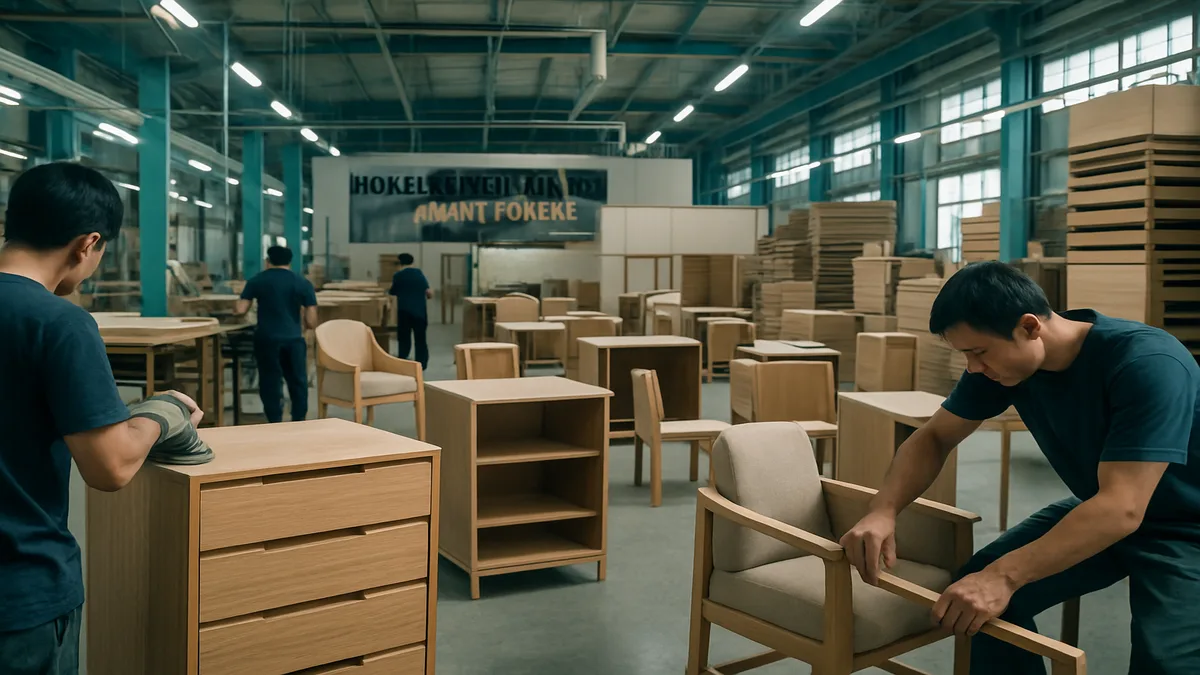
China produces an estimated 35-40% of the world’s hotel furniture. The cluster of factories around Foshan, Guangdong Province alone ships hotel case goods, upholstery, and custom millwork to properties on six continents. For hotel suppliers looking to build or expand their product lines, sourcing from Chinese factories offers unmatched production capacity, competitive pricing, and an established export infrastructure.
But the gap between “finding a factory on Alibaba” and “reliably delivering hotel-grade furniture to brand standards” is enormous. That gap is where margins get destroyed, timelines collapse, and hotel client relationships end.
This guide covers the entire sourcing process: factory identification, vetting, quality control, shipping logistics, payment terms, and the specific pitfalls that catch hotel furniture suppliers year after year.
China’s Hotel Furniture Manufacturing Hubs
Hotel furniture production in China is concentrated in several regional clusters, each with distinct specializations. Understanding which region produces what helps you target the right factories from the start.
Factory Region Comparison Table
| Region | Primary Specialization | Typical Factory Size | Price Level | Quality Range | Export Infrastructure |
|---|---|---|---|---|---|
| Foshan, Guangdong | Hotel case goods, bedroom sets, lobby furniture, restaurant furniture | 200-2,000+ workers | Medium-High | Mid to High | Excellent (major port access via Nansha/Shenzhen) |
| Dongguan, Guangdong | Upholstered furniture, sofas, headboards, banquette seating | 100-1,000 workers | Medium-High | Mid to High | Excellent (Shenzhen/Hong Kong ports) |
| Shenzhen, Guangdong | Custom furniture, high-end pieces, modern/contemporary designs | 50-500 workers | High | High | Excellent (Shenzhen port, immediate export) |
| Zhangzhou, Fujian | Wooden furniture, traditional styles, carved pieces | 50-500 workers | Low-Medium | Low to Mid | Moderate (Xiamen port, 2-3 hours) |
| Anji, Zhejiang | Office chairs, conference room seating | 100-500 workers | Medium | Mid | Good (Shanghai port, 3-4 hours) |
| Tianjin/Hebei | Metal furniture, steel frame beds, institutional furniture | 100-1,000 workers | Low-Medium | Low to Mid | Good (Tianjin port) |
| Hangzhou/Huzhou, Zhejiang | Outdoor furniture, patio sets, pool furniture | 100-500 workers | Medium | Mid to High | Good (Ningbo/Shanghai ports) |
Foshan is the center of gravity. The city’s Shunde and Nanhai districts house thousands of furniture factories, from small workshops to massive operations producing 10,000+ hotel room sets annually. If you are sourcing hotel bedroom furniture, Foshan is where you start.
Dongguan dominates upholstery. Hotel headboards, lobby sofas, restaurant booth seating, and custom upholstered pieces are Dongguan’s specialty. Many factories here serve both the domestic Chinese hotel market and international hospitality brands.
The Canton Fair: Your Starting Point for Factory Discovery
The China Import and Export Fair (Canton Fair) in Guangzhou is the single most efficient way to meet hotel furniture manufacturers face-to-face. Held twice annually (Phase 1 in April, Phase 2 in October), the fair attracts 25,000+ exhibitors across all product categories.
Hotel furniture exhibitors are concentrated in the Home Decoration section of Phase 2, though some appear in Phase 1 under Building Materials and Interior Design.
Canton Fair Strategy for Hotel Suppliers
Before the fair:
- Register online at cantonfair.org.cn (free for buyers)
- Search the exhibitor list by product category and filter for “hotel furniture” or “hospitality furniture”
- Pre-schedule meetings with 10-15 target factories
- Prepare specification sheets for your top-priority products with dimensions, materials, finish requirements, and brand standard references
At the fair:
- Visit pre-scheduled meetings first, then walk the relevant halls for discovery
- Collect physical samples (small hardware, finish swatches, fabric samples)
- Ask every factory: Do you have existing hotel projects? Which brands/chains? Can I visit your showroom in Foshan?
- Photograph everything with detailed notes (factory name, booth number, product, quoted price range)
After the fair:
- Visit the top 3-5 factories at their Foshan/Dongguan facilities within 2-3 days
- See the actual production floor, not just the showroom
- Request references from other international hotel suppliers they work with
Factory Vetting: The 8-Point Checklist
Visiting a factory showroom tells you what they want you to see. Proper vetting reveals whether they can actually deliver hotel-grade furniture at the volumes and timelines you need.
1. Business License and Export History
Verify the factory’s business license (Yingye Zhizhao) and export license. Check their registration on the National Enterprise Credit Information Publicity System (gsxt.gov.cn). Confirm they have direct export experience, not just domestic sales with a trading company handling exports.
2. Production Capacity and Current Load
Ask for current production capacity and utilization. A factory producing 500 hotel room sets per month that is currently running at 90% capacity will struggle with a 300-room order on a tight timeline. Ideal utilization for reliable delivery: 60-75%.
3. Existing Hotel Projects
Request a client list with specific hotel projects completed in the last 2 years. Verify at least 2-3 references by contacting the hotel or the supplier who placed the order. Ask for photos of installed furniture at actual hotel properties.
4. Quality Management System
Look for ISO 9001 certification as a baseline. More important: walk the production floor and observe quality checkpoints. Are there inspection stations between production stages? Is there a dedicated QC team, or does the factory owner’s nephew eyeball everything?
5. Material Sourcing
Where does the factory source its wood, metal, fabric, and hardware? Factories using certified wood suppliers (FSC or PEFC) are better positioned for hotel chains with sustainability requirements — and sustainability certifications grew 20% between 2022 and 2023. Ask to see material certificates and supplier invoices.
6. Fire Safety Compliance
Hotel furniture must meet fire safety standards in the destination country (Cal 117 in the U.S., BS 5852 in the UK, EN 1021 in the EU). Verify the factory understands these standards and has test reports from accredited labs (SGS, Bureau Veritas, Intertek). This is non-negotiable for hotel projects.
7. Sample Capability
Can the factory produce pre-production samples that match your exact specifications? Sample quality and turnaround time (typically 15-25 days) are a reliable indicator of production quality. If they cannot get the sample right, they will not get the production run right.
8. Financial Stability
A factory that looks busy but has cash flow problems may cut corners on materials or collapse mid-order. Ask about their banking relationships, check for any legal disputes on Chinese court databases (wenshu.court.gov.cn), and consider running a third-party credit check through a service like Sinosure.
Quality Control: The Three-Stage Protocol
Quality control for hotel furniture sourced from China requires intervention at three stages. Relying on final inspection alone guarantees problems.
Stage 1: Pre-Production Sample Approval
Timeline: 15-25 days from deposit payment
What to verify:
- Dimensions match specifications within acceptable tolerances (typically +/- 3mm for case goods)
- Finish color matches approved sample or Pantone/RAL reference
- Hardware function (drawer slides, door hinges, locks) operates smoothly
- Upholstery fabric matches approved memo sample in color, texture, and pattern alignment
- Construction method matches agreed specification (solid wood vs. engineered wood, joinery type)
Action: Approve sample in writing with a signed sample confirmation form. Retain a sealed reference sample for comparison during production.
Stage 2: In-Line Inspection (During Production)
Timeline: When 30-40% of the order is complete
What to verify:
- Materials match approved samples (wood species, hardware, fabric)
- Construction is consistent across units (no substitutions or shortcuts)
- Finish quality is uniform (no color variation between batches)
- Assembly tolerances are maintained
- Packaging materials and method are correct
Who does it: Either your own QC staff based in China, or a third-party inspection company (SGS, Bureau Veritas, Asia Inspection, QIMA). Cost: typically $250-350 per man-day.
Action: Document findings with photos. Issue corrective action requests for any deviations. Do not wait until final inspection to discover that the factory switched from solid wood to MDF on the drawer boxes.
Stop chasing hotels manually. InnLead.ai’s 12 AI agents scan renovation signals, identify procurement contacts, and book meetings with hotel buyers — automatically. Get Early Access
Stage 3: Final Pre-Shipment Inspection
Timeline: When 100% of the order is packed and ready for loading
What to verify:
- Random sample selection (AQL 2.5 for major defects, AQL 4.0 for minor)
- All items match approved sample
- Function testing (open/close all drawers, doors, mechanisms)
- Drop testing for packaging adequacy
- Carton markings, packing list accuracy, container loading plan
Action: Issue pass or fail. If fail, the factory corrects at their cost before you authorize shipment. This is why your contract must include a pre-shipment inspection clause with the right to reject.
Shipping: FOB vs. CIF and What It Actually Costs
Understanding shipping terms is the difference between controlling your landed cost and being surprised by $15,000 in unexpected charges at destination.
| Shipping Term | What It Means | What Supplier Pays | What Buyer Pays | Best For |
|---|---|---|---|---|
| FOB (Free on Board) | Seller delivers goods onto the vessel at the port of origin | Production + inland transport to port + loading | Ocean freight + insurance + customs + inland delivery | Experienced importers who have freight forwarder relationships |
| CIF (Cost, Insurance, Freight) | Seller arranges and pays for ocean freight and insurance to destination port | Production + inland transport + loading + ocean freight + insurance | Customs clearance + duties + inland delivery from port | First-time importers who want fewer logistics to manage |
| DDP (Delivered Duty Paid) | Seller handles everything to buyer’s warehouse | All costs including duties and destination delivery | Nothing (price is fully landed) | Small orders where convenience outweighs cost control |
The typical arrangement for hotel furniture orders: FOB Nansha or FOB Shenzhen, with the buyer’s freight forwarder handling ocean transit. This gives the buyer control over shipping costs, insurance coverage, and transit time.
Current shipping cost benchmarks (2024):
- 40-foot container, Foshan to U.S. West Coast: $3,000-5,500
- 40-foot container, Foshan to U.S. East Coast: $4,500-7,500
- 40-foot container, Foshan to Europe: $3,500-6,000
- 40-foot container, Foshan to Middle East: $2,000-3,500 (see our guide to selling hotel supplies in the Middle East for regional distribution strategies)
These rates fluctuated wildly during the supply chain disruption of 2021-2022, when container costs hit 5-6x pre-pandemic levels. Rates have normalized significantly since late 2022, though they remain above pre-pandemic baselines. Timber prices increased 35% between 2022 and 2024, which affects raw material costs independently of shipping.
Payment Terms: Standard Structures and Risk Mitigation
The standard payment structure for hotel furniture orders from Chinese factories follows a deposit-plus-balance model. Negotiating the right terms protects both parties.
| Payment Stage | Typical % | When Due | Purpose |
|---|---|---|---|
| Deposit | 30% | Upon order confirmation / before production starts | Covers factory’s raw material procurement |
| Mid-Production Payment | 0-30% | At in-line inspection approval (optional) | Used for large orders; releases funds for continued production |
| Balance | 40-70% | After pre-shipment inspection approval, before B/L release | Factory releases shipping documents upon receipt |
The standard split is 30/70: 30% deposit to start production, 70% balance upon pre-shipment inspection approval. Some factories push for 50/50 on first orders. Experienced buyers negotiate down to 20/80 after establishing a track record.
Payment methods:
- T/T (Telegraphic Transfer): Most common. Wire transfer to factory’s bank account.
- L/C (Letter of Credit): Recommended for orders above $50,000 from first-time factory relationships. The bank guarantees payment upon document compliance. Costs 1-3% of order value but eliminates payment risk.
- Escrow services: Alibaba Trade Assurance provides escrow-like protection for orders placed through the platform. Useful for smaller orders.
Never pay 100% upfront. Any factory demanding full payment before production is either desperate for cash or planning to cut corners with no financial accountability.
Lead Times: What to Actually Expect
| Phase | Duration | Variables |
|---|---|---|
| Sample development | 15-25 days | Complexity of design, factory current workload |
| Sample shipping (to you) | 5-10 days (express) | Destination country |
| Sample revision (if needed) | 10-15 days | Scope of changes |
| Production (after deposit) | 45-90 days | Order size, product complexity, factory capacity |
| Packing and loading | 3-7 days | Order size |
| Ocean transit | 18-35 days | Destination (West Coast U.S. ~18-22 days, East Coast ~28-35 days, Europe ~25-30 days) |
| Customs clearance | 3-10 days | Documentation accuracy, inspection likelihood |
Total timeline from order confirmation to warehouse delivery: 90-150 days.
For hotel projects with fixed opening dates, this means placing orders 5-6 months before the furniture needs to be installed. Factor in installation time (typically 2-4 weeks for a 200-room hotel), and you are looking at 6-7 months of lead time from factory order to guest-ready rooms.
Import Duties and Compliance
Import duties on Chinese hotel furniture vary by product category and destination country.
U.S. HTS codes and duty rates (approximate):
- Wooden hotel furniture (HTS 9403.50): 0% base duty + potential Section 301 tariff (currently 25% on most Chinese furniture)
- Metal furniture (HTS 9403.20): 0% base duty + potential Section 301 tariff
- Upholstered seating (HTS 9401.61): 0% base duty + potential Section 301 tariff
- Mattresses (HTS 9404.21): 0-6% base duty + potential anti-dumping duties
Section 301 tariffs have added 25% to most Chinese furniture imports since 2018. Some hotel suppliers mitigate this through:
- Transshipment (routing through Vietnam or other countries — risky and legally questionable if the substantial transformation does not occur there)
- Duty drawback programs for re-exported goods
- Tariff engineering: structuring products to qualify under lower-duty HTS classifications (requires customs expertise)
- Vietnam/Indonesia sourcing: Some Chinese factory groups have opened facilities in Vietnam specifically to serve markets affected by Section 301 tariffs. Vietnam saw the strongest reshoring-related sales increase globally, and 57% of companies reported nearshoring as key to supply chain strategy in 2023.
Common Pitfalls and How to Avoid Them
1. Confusing Trading Companies with Factories
Many “factories” advertising on Alibaba and at Canton Fair are actually trading companies that outsource production. Trading companies add 10-25% markup and reduce your quality control visibility. Verify by visiting the production facility yourself or through a third-party audit.
2. Accepting the First Price Quote
Chinese furniture factory pricing is negotiable. First quotes typically include 15-25% margin for negotiation. Get quotes from 3-5 factories for the same specification and use competitive pricing to negotiate. But do not squeeze price to the point where the factory must cut material quality to maintain margin.
3. Skipping Fire Safety Testing
Hotel furniture that fails fire safety inspection at the destination cannot be installed. It sits in a warehouse while you pay storage fees, miss your hotel opening deadline, and potentially lose the project. Test early, test with accredited labs, and specify fire safety compliance in your purchase order.
4. Underspecifying Materials
“Solid wood” in China can mean anything from genuine hardwood to finger-jointed pine to engineered wood with a veneer. Your purchase order must specify exact species, grade, moisture content, and construction method. Include cross-sectional diagrams if necessary. Ambiguity benefits the factory, not you.
5. Ignoring Packaging Quality
A perfectly made desk that arrives with a cracked top because the packaging was inadequate is not a production problem — it is a specification failure. Specify packaging standards: corner protectors, double-wall cartons, foam lining for polished surfaces, and fumigation certificates for wooden crates (ISPM 15 compliance).
6. No Written Contract in Chinese
Your English-language purchase order may not be enforceable in Chinese courts. Have a bilingual contract drafted (English and Mandarin) that specifies product specifications, quality standards, inspection rights, delivery timeline, payment terms, and penalty clauses for non-conformance. Both versions should be legally binding.
Minimum Order Quantities: What to Expect
MOQs vary by product type and factory size. Understanding typical minimums helps you plan order consolidation and pricing negotiations.
| Product Type | Typical MOQ (pieces) | Notes |
|---|---|---|
| Case goods (desks, nightstands, dressers) | 50-100 pieces per item | Larger factories may require 200+ |
| Beds (frames and headboards) | 50-100 units | Custom sizes add complexity |
| Upholstered seating (chairs, sofas) | 30-80 pieces | Fabric MOQs may be separate (500+ meters) |
| Dining/restaurant furniture | 100-200 pieces | Stackable chairs: 200+ minimum |
| Lobby and public area furniture | 20-50 pieces | Custom items have lower MOQs but higher unit cost |
| Bathroom vanities | 50-100 units | Stone tops may have separate MOQs |
Negotiation tactics for MOQs:
- Combine items across a project. A factory will accept lower MOQs per item if you order multiple product types (e.g., desks + nightstands + dressers from the same factory).
- Commit to a second order. Offer a letter of intent for a follow-up order within 6 months. Factories prioritize repeat customers.
- Accept slightly higher unit pricing. Most factories will reduce MOQs by 30-50% if you accept a 10-15% price premium on smaller runs.
The Nearshoring Alternative
The China sourcing model is not the only option anymore. Mexico audit/inspection demand from U.S. buyers increased 17% year-over-year in Q3 2023. Vietnam is attracting Chinese factory investment specifically to serve tariff-affected markets. And 26% of companies globally are planning to nearshore in 2025, with 33% in the U.S.
Alternative Sourcing Regions Comparison
| Region | Strengths | Weaknesses | Best For |
|---|---|---|---|
| Vietnam | Lower tariffs for U.S. imports, growing factory investment from Chinese manufacturers, competitive labor costs | Smaller factory scale, fewer specialized hotel furniture producers, longer ramp-up for new relationships | Suppliers seeking tariff mitigation with acceptable quality |
| Mexico | Proximity to U.S. market (2-5 day shipping vs. 18-35 days from China), USMCA tariff benefits, growing furniture cluster in Jalisco | Higher labor costs than Asia, smaller production capacity, limited luxury furniture expertise | U.S.-focused suppliers prioritizing speed and reduced shipping risk |
| Indonesia | Strong wood furniture tradition, competitive pricing, growing export infrastructure | Longer lead times than China, less developed QC infrastructure, fewer hotel-specific factories | Wood furniture specialists, outdoor/teak products |
| India | Large manufacturing base, English-speaking workforce, growing hotel furniture sector | Inconsistent quality across factories, infrastructure challenges, variable lead times | Suppliers developing long-term alternative to China |
But China’s hotel furniture ecosystem — the depth of factory specialization, the supplier clustering in Foshan, and the production scale — remains unmatched. China’s hotel pipeline alone stands at 3,788 projects and 691,772 rooms, the second-largest globally after the U.S. For full regional breakdowns, see our analysis of the record global hotel construction pipeline and the Asia-Pacific hotel supply market entry guide. The domestic market creates a factory ecosystem that serves both Chinese and international hotel projects, ensuring production expertise and capacity that no other region can currently match.
For hotel suppliers who need 500+ room sets at competitive prices with customizable designs, China sourcing will remain the dominant approach for the foreseeable future.
The key is doing it right: vet factories thoroughly, control quality at every stage, structure payments to maintain leverage, and build relationships that compound over multiple orders. The suppliers who treat China sourcing as a long-term capability rather than a one-time transaction build the most reliable and profitable distribution networks from factory floor to hotel door. For a deeper understanding of what hotels spend on furniture and how procurement works, see our complete guide to hotel FF&E. Contact InnLead.ai to find hotel buyers actively procuring FF&E for new projects.
Use these related guides to keep moving through the same procurement, sales, or market research thread.
Skip the Manual Work
InnLead.ai's 12 AI agents find hotels buying your products, identify procurement contacts, and book meetings -- automatically.
Get Early Access