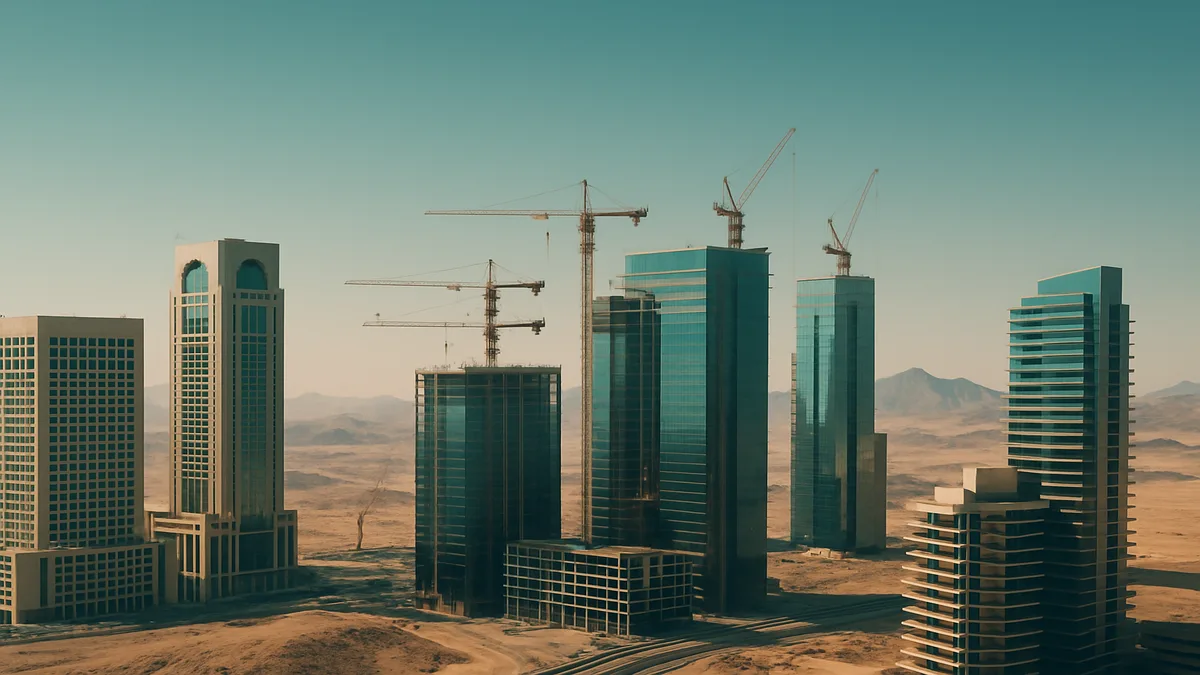
Saudi Arabia’s hotel construction pipeline has reached an all-time high: 349 projects encompassing 94,287 rooms, representing a 10% increase in projects and an 18% increase in rooms year-over-year. These are not incremental numbers. This is the largest hotel construction surge in the history of the Middle East, driven by a government that has committed over $100 billion to transforming the Kingdom into a global tourism destination.
For hotel suppliers — FF&E manufacturers, linen companies, amenity producers, technology providers, and every category in between — Saudi Arabia represents the single largest concentrated procurement opportunity in the world right now. For broader context on selling hotel supplies across the entire Middle East and Gulf region, see our regional overview. But entering the Saudi market requires understanding its unique procurement processes, local content requirements, mega-project structures, and cultural business norms.
This guide provides the data, context, and actionable intelligence you need to capture your share.
The Scale of the Opportunity
Pipeline Numbers in Context
| Metric | Saudi Arabia | UAE | Total Middle East |
|---|---|---|---|
| Total projects | 349 | 136 | 659 |
| Total rooms | 94,287 | — | 163,816 |
| YoY project growth | +10% | — | +8% |
| YoY room growth | +18% | — | — |
| Share of regional pipeline | 53% | 21% | 100% |
Saudi Arabia accounts for more than half of the entire Middle East hotel pipeline. When the broader Middle East pipeline itself is at an all-time record of 659 projects and 163,816 rooms, that concentration is significant.
The Luxury Tilt
The Middle East pipeline skews heavily toward premium properties:
- Luxury segment: Record 199 projects / 44,059 rooms
- Upscale segment: 166 projects / 47,974 rooms
- Luxury + upscale combined: 55% of the total Middle East pipeline
For suppliers, this means the average per-room procurement spend is substantially higher than in markets dominated by midscale and economy development. Luxury and upscale hotels spend 3-5x more per room on FF&E, linens, amenities, and technology than economy properties.
The Mega-Projects Driving Demand
NEOM
NEOM is a $500 billion mega-city project on the Red Sea coast, envisioned as a hub for tourism, technology, and sustainable living. Its hospitality components include:
- THE LINE: A 170-kilometer linear city designed by some of the world’s leading architects. Hospitality elements are integrated throughout.
- TROJENA: A mountain resort destination planned to host the 2029 Asian Winter Games, featuring ski facilities, wellness retreats, and luxury hotels.
- Sindalah: A luxury island resort in the Red Sea, positioned as a yachting and wellness destination. Among the first NEOM components to open.
- Oxagon: An industrial and innovation zone with associated hospitality development.
Procurement reality: NEOM operates through NEOM Company, a Saudi sovereign entity. Procurement is centralized and heavily controlled. Suppliers typically engage through tier-1 contractors and procurement management firms rather than directly with the end operator.
Red Sea Global (RSG)
Red Sea Global is developing two major resort destinations:
- The Red Sea: A luxury resort destination across 50+ islands, featuring 16 hotels in its initial phase. Brands include St. Regis, Ritz-Carlton Reserve, and Six Senses.
- AMAALA: An ultra-luxury wellness and lifestyle destination on the northwestern coast, targeting the world’s wealthiest travelers.
RSG has committed to aggressive sustainability targets: 100% renewable energy, net-positive biodiversity impact, and zero waste to landfill. For suppliers, this means sustainability certifications are not optional — they are procurement requirements.
Diriyah Gate
A $20 billion heritage and cultural destination on the outskirts of Riyadh, Diriyah Gate will include luxury hotels (Aman, Orient Express by Accor, and others), museums, retail, and entertainment. The project emphasizes traditional Najdi architectural design, which creates demand for specialized FF&E and artisanal products.
Entertainment Mega-Projects
- Qiddiya: A 367-square-kilometer entertainment city south of Riyadh featuring theme parks, sports facilities, and resort hotels.
- ROSHN: Saudi Arabia’s largest community developer, building integrated residential and hospitality communities across the Kingdom.
- Jeddah Tower (Kingdom Tower): When completed, the world’s tallest building, with a Four Seasons hotel component.
Vision 2030 Tourism Targets
Saudi Arabia’s Vision 2030 includes specific, government-mandated tourism targets:
| Target | Metric |
|---|---|
| Annual tourism visits by 2030 | 150 million (domestic + international) |
| Tourism GDP contribution target | 10% of GDP (up from ~3%) |
| Tourism jobs created | 1 million+ new positions |
| Heritage sites developed | 6 UNESCO World Heritage Sites promoted for tourism |
| Entertainment spend | $64 billion in entertainment development |
The 150-million-visits target is the most important number for suppliers. It translates directly to hotel rooms needed, which translates to procurement volume.
Stop chasing hotels manually. InnLead.ai’s 12 AI agents scan renovation signals, identify procurement contacts, and book meetings with hotel buyers — automatically. Get Early Access
Saudi-Specific Procurement Processes
How Procurement Works in Saudi Mega-Projects
The procurement chain in Saudi hotel development is longer and more layered than in most Western markets:
Government Entity / Developer (e.g., NEOM Company, Red Sea Global)
    |
    v
Master Development Company
    |
    v
Tier-1 Contractor (construction, fit-out)
    |
    v
Procurement Management Firm / FF&E Installer
    |
    v
Supplier (you)
Key implications:
-
You are typically 3-4 levels removed from the end decision-maker. Direct sales to the developer or hotel operator are rare during the construction phase. Most purchasing flows through contractors and procurement management firms.
-
Pre-qualification is mandatory. Before you can supply any Saudi government-linked project, you must be pre-qualified. This involves submitting company documentation, financial statements, quality certifications, and references through formal pre-qualification questionnaires (PQQs).
-
Tenders are formal and structured. Expect multi-round tender processes with detailed technical evaluations, commercial scoring, and negotiation phases.
The Pre-Qualification Process
| Step | Requirement | Timeline |
|---|---|---|
| 1. Registration | Register on the developer’s or contractor’s vendor portal | 1-2 weeks |
| 2. PQQ submission | Submit pre-qualification questionnaire with full documentation | 2-4 weeks to prepare |
| 3. Documentation | Company registration, financial audits, insurance certificates, quality certifications, references | Must be current |
| 4. Review | Procurement team evaluates submission | 4-8 weeks |
| 5. Approval | Added to approved vendor list (AVL) | If successful |
| 6. Tender invitation | Receive invitations to bid on specific projects | Ongoing |
Critical documents for Saudi pre-qualification:
- Commercial Registration (CR) certificate — Saudi entity or authorized agent
- Chamber of Commerce membership
- GOSI (General Organization for Social Insurance) certificate
- Saudization compliance documentation
- ISO certifications (9001, 14001)
- Product-specific certifications (OEKO-TEX, fire safety, etc.)
- Bank reference letters
- Audited financial statements (3 years)
Local Content Requirements: The Iktva Factor
Saudi Arabia mandates increasing local content in procurement across government and semi-government projects. This is implemented through the In-Kingdom Total Value Add (IKTVA) program and similar frameworks.
What Local Content Means for Suppliers
| Approach | Description | Complexity | Local Content Score |
|---|---|---|---|
| Direct export | Ship from overseas factory to Saudi project | Lowest | Lowest score |
| Saudi warehouse/distribution | Maintain inventory in Saudi Arabia | Low | Moderate score |
| Saudi assembly/finishing | Import components, assemble or finish in-Kingdom | Medium | Good score |
| Saudi manufacturing | Full or partial manufacturing in Saudi Arabia | High | Highest score |
| Saudi JV/partnership | Joint venture with Saudi-owned company | Medium-High | Good score |
| Saudi agent/distributor | Appoint a licensed Saudi commercial agent | Low-Medium | Moderate score |
The practical reality: For most international suppliers, the minimum viable approach is appointing a Saudi commercial agent or establishing a distribution partnership with a Saudi company. This provides a local presence, handles customs clearance and delivery, and contributes to local content scoring.
For suppliers with significant Saudi volume potential, establishing a Saudi warehouse or assembly operation meaningfully improves competitiveness in tenders.
Saudization (Nitaqat)
Any entity operating in Saudi Arabia must comply with Saudization requirements — mandatory percentages of Saudi national employees. This affects suppliers who establish Saudi operations:
- Service-sector companies: Minimum thresholds vary by company size and sector
- Higher Saudization percentages earn “Platinum” or “Green” status, which facilitates government procurement access
- Non-compliant companies face restrictions on visa issuance and government contract eligibility
Payment Terms and Financial Considerations
Saudi payment terms require specific planning:
| Factor | Typical Terms | Notes |
|---|---|---|
| Payment terms (private projects) | Net-60 to Net-90 | Major chains follow global norms |
| Payment terms (government/mega-projects) | Net-90 to Net-120 | Longer for sub-contractors |
| Currency | Saudi Riyal (SAR), pegged to USD at 3.75 | No currency risk for USD-denominated suppliers |
| Retention | 5-10% retention for 6-12 months post-delivery | Standard for project-based supply |
| Advance payment | 10-30% advance common for custom/large orders | Negotiate this aggressively |
| Letter of credit | Available for large orders | Recommended for first-time transactions |
| VAT | 15% (introduced 2020) | Include in pricing calculations |
Cash flow warning: The combination of long payment terms and retention can create significant cash flow gaps. A supplier delivering $500,000 in FF&E to a mega-project contractor might wait 90-120 days for 90% of the payment and another 6-12 months for the 10% retention. Factor this into your financial planning and pricing.
Key Contacts and Organizations
Government and Regulatory
| Organization | Role | Relevance to Suppliers |
|---|---|---|
| Saudi Tourism Authority (STA) | National tourism promotion and regulation | Tourism policy, licensing, events |
| Ministry of Tourism | Tourism sector governance | Hotel classification, regulations |
| Royal Commission for AlUla | Development of AlUla heritage tourism destination | Procurement for AlUla hotel projects |
| Saudi Standards, Metrology and Quality Org. (SASO) | Product standards and conformity assessment | Product certification requirements |
| General Authority of Foreign Trade | Foreign investment facilitation | Business setup, import regulations |
Developer and Mega-Project Entities
| Entity | Projects | Procurement Approach |
|---|---|---|
| NEOM Company | THE LINE, TROJENA, Sindalah, Oxagon | Centralized; through tier-1 contractors |
| Red Sea Global | The Red Sea, AMAALA | Centralized; strong sustainability requirements |
| Diriyah Gate Development Authority | Diriyah Gate | Centralized; heritage design focus |
| Qiddiya Investment Company | Qiddiya entertainment city | Centralized; entertainment-hospitality focus |
| ROSHN | Community and hospitality developments | Centralized |
Trade Shows and Events (Saudi/Middle East)
| Event | Location | Timing | Focus |
|---|---|---|---|
| The Hotel Show Dubai | Dubai World Trade Centre | May-June annually | Full hospitality supply chain; grew to 1,000+ exhibitors in 2024 |
| Arabian Travel Market (ATM) | Dubai | April-May annually | 2,800+ exhibitors; 55,000+ visitors from 166 nations |
| Future Hospitality Summit (FHS) | Saudi Arabia (Riyadh) | Annual | Hotel investment and development focus |
| Saudi Horeca | Riyadh | Annual | Food, beverage, and hospitality equipment |
| The Big 5 Saudi | Riyadh | Annual | Construction materials and building services |
The Hotel Show Dubai deserves particular attention: it grew from 300 exhibiting firms in 2022 to 1,000+ firms from 48 nations in 2024, with 34,000+ visitors. The 2024 edition included a dedicated Hospitality Procurement Forum. For suppliers targeting Saudi Arabia, this is the single most efficient regional trade show. Our 2026 hotel trade show calendar includes confirmed dates, costs, and ROI strategies for every major event.
Supply Categories With Strongest Saudi Demand
The luxury and upscale tilt of the Saudi pipeline creates outsized demand in specific product categories:
High-Demand Categories
| Category | Demand Driver | Estimated Per-Room Spend (Luxury) | Opportunity Size |
|---|---|---|---|
| FF&E (furniture, fixtures, equipment) | 94,000+ rooms in pipeline | $15,000-$25,000 per room | $1.4B-$2.4B |
| Textiles and linens | Full par-level stocking for new properties | $2,000-$5,000 per room | $188M-$470M |
| Bathroom amenities and dispensers | EU-style sustainability focus | $500-$1,500 per room annually | $47M-$141M |
| Technology (smart room, IPTV, IoT) | Brand-new properties with latest tech | $3,000-$8,000 per room | $282M-$752M |
| Lighting | Architectural and decorative for luxury properties | $2,000-$6,000 per room | $188M-$564M |
| Kitchen and F&B equipment | Resort and destination dining emphasis | $5,000-$15,000 per room (F&B areas) | Variable by property |
Sustainability as a Market Entry Requirement
The sustainability angle in Saudi Arabia differs from Western markets. While European and North American sustainability is driven largely by regulation and consumer preference, Saudi sustainability is driven by developer mandate. Red Sea Global’s commitment to 100% renewable energy, net-positive biodiversity, and zero waste to landfill means every supplier to RSG projects must demonstrate:
- Carbon footprint data for products supplied
- Recyclable or biodegradable packaging
- Ethical labor and sourcing certifications
- Compliance with RSG’s proprietary sustainability scorecard
NEOM has similar requirements tied to its positioning as a sustainable mega-city. Suppliers who lack sustainability documentation are excluded from these projects entirely — and these projects represent a substantial share of the total pipeline.
Cultural Business Norms
Relationship and Trust
Saudi business culture is relationship-intensive. Transactions follow trust, not the reverse. Key norms:
- Face-to-face meetings are expected before any significant business commitment. Video calls are acceptable for initial discussions, but in-person visits to Saudi Arabia signal serious intent.
- Personal relationships with decision-makers matter. Saudi procurement often involves personal recommendations and trusted networks.
- Patience is required. Decision timelines in Saudi Arabia can be longer than in Western markets. Rushing or pressuring is counterproductive.
- Hospitality is reciprocal. Accept invitations to meals and social events. Extend the same when hosting Saudi business partners.
Communication Protocols
- Arabic is preferred for formal documentation, though English is widely used in business. Providing bilingual materials (Arabic/English) demonstrates respect and professionalism.
- Formal titles matter. Use “Sheikh,” “Dr.,” or appropriate honorifics until invited to use first names.
- Business cards should be presented with both hands or the right hand. Having an Arabic translation on one side is a strong gesture.
Calendar Considerations
- Ramadan: Business slows significantly during Ramadan (dates shift annually based on lunar calendar). Avoid scheduling major proposals or negotiations during this period. Post-Ramadan (Eid al-Fitr) is an excellent time for relationship-building.
- Summer months (June-August): Many Saudi business leaders travel abroad. Schedule in-Kingdom meetings for September-May.
- Thursday-Friday weekend: Saudi Arabia’s weekend is Friday-Saturday. The business week runs Sunday through Thursday.
Building Your Saudi Market Entry Strategy
Phase 1: Foundation (Months 1-3)
- Identify your target segment within the Saudi pipeline (mega-projects, international chains, independent luxury)
- Appoint a Saudi commercial agent or distribution partner
- Begin pre-qualification with target developers and tier-1 contractors
- Prepare Arabic-language marketing materials and product documentation
- Obtain SASO product conformity certifications if required for your category
Phase 2: Market Entry (Months 4-8)
- Attend The Hotel Show Dubai or ATM for regional exposure
- Visit Saudi Arabia for face-to-face meetings with agent, potential clients, and project representatives
- Submit pre-qualification questionnaires to developer vendor portals
- Send product samples to identified project procurement managers
- Register on Saudi government procurement portals (Etimad, Monafasat)
Phase 3: Tender and Contract (Months 9-18)
- Respond to tender invitations received through approved vendor status
- Price competitively — include local content considerations in pricing strategy
- Negotiate contracts with attention to payment terms, retention, and delivery schedules
- Establish logistics — identify freight forwarders, customs brokers, and local warehousing
- Deliver and perform — first-order execution is critical for repeat business in Saudi Arabia
The Competitive Landscape
Foreign suppliers entering Saudi Arabia will compete against:
- Chinese manufacturers with aggressive pricing and established Saudi distribution
- Turkish suppliers with geographic proximity, competitive pricing, and growing Saudi trade relationships
- Indian manufacturers with cost advantages and a large Saudi diaspora workforce
- European premium brands with luxury credibility and brand recognition
- Established Saudi and GCC-based distributors who already hold approved vendor status with key developers
Differentiation strategies that work:
- Sustainability credentials — Red Sea Global and other developers have mandatory sustainability procurement criteria
- Brand-specific approvals — if you are already an approved vendor for Marriott, Hilton, or Accor globally, leverage this for their Saudi properties
- Speed and reliability — mega-projects operate on tight timelines with heavy penalties for delays. Demonstrated delivery reliability is a competitive weapon
- Technical innovation — smart textiles, energy-efficient fixtures, and technology-integrated products attract attention in a market building from scratch
Key Takeaways
- Saudi Arabia’s hotel pipeline (349 projects / 94,287 rooms) is the largest concentrated procurement opportunity in the world right now, representing over 53% of the Middle East’s total pipeline.
- Mega-projects (NEOM, Red Sea Global, Diriyah Gate) drive procurement through layered contractor structures. Direct-to-developer sales are rare; work through the supply chain.
- Pre-qualification is mandatory before you can bid on any project. Start the process immediately — it takes months.
- Local content requirements favor suppliers with Saudi presence — at minimum, a licensed Saudi commercial agent.
- Payment terms are long (Net-90 to Net-120) with retention. Plan your cash flow accordingly.
- Sustainability is a procurement requirement, not a differentiator, at Red Sea Global and other ESG-committed developers.
- Relationship-building is essential. Visit Saudi Arabia, invest in personal connections, and be patient. The rewards justify the effort — this pipeline will be under construction for the next decade. To see how Saudi fits within the record global hotel construction pipeline and compare it with the fast-growing Asia-Pacific market, explore our regional analyses. Contact InnLead.ai to identify Saudi procurement contacts and project timelines automatically.
Use these related guides to keep moving through the same procurement, sales, or market research thread.
Skip the Manual Work
InnLead.ai's 12 AI agents find hotels buying your products, identify procurement contacts, and book meetings -- automatically.
Get Early Access