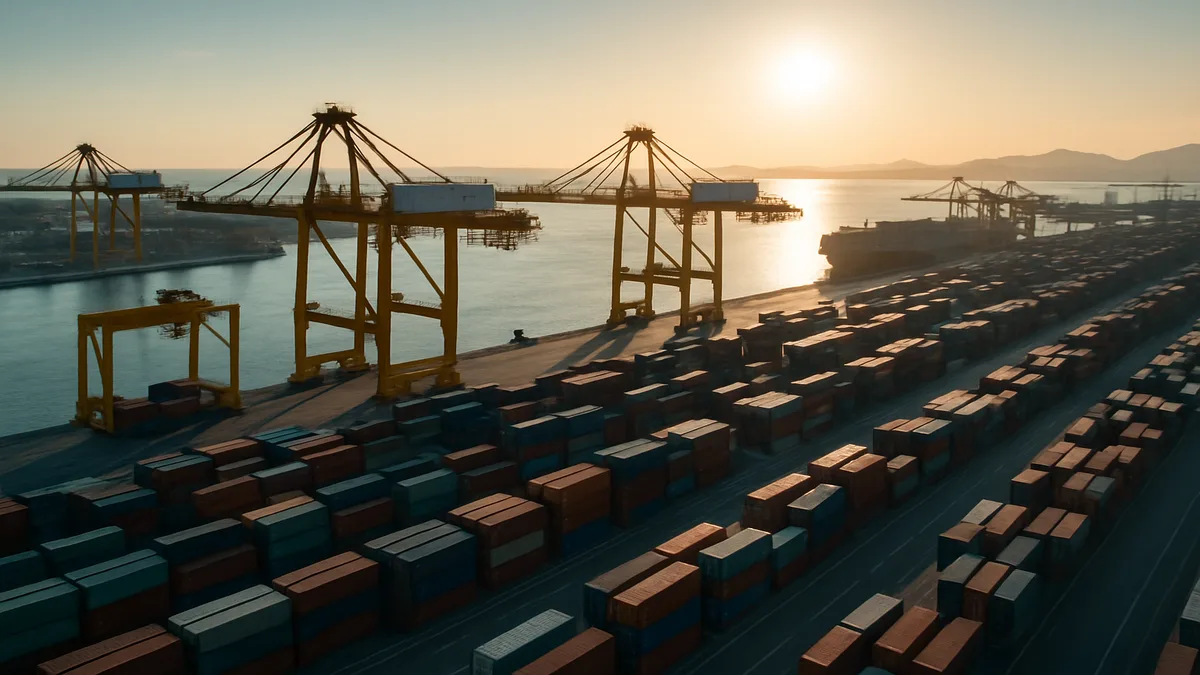
Container shipping costs hit 5-6x pre-pandemic levels through 2021 and into 2022. Port backlogs stretched delivery windows from weeks to months. Timber prices climbed 35% between 2022 and 2024. And somewhere in the middle of all of it, the global hotel industry decided it was time to start building again — with the U.S. pipeline alone reaching nearly 6,000 projects by late 2023.
If you supply products to hotels, you spent the last two years navigating the most disrupted supply chain in modern hospitality history. Now the question is whether you are positioned for what comes next.
The State of Hotel Supply Chains in 2022
What Broke and Why
The pandemic did not just pause hotel procurement — it shattered the logistics infrastructure that the industry depended on. Here is what suppliers faced through early-to-mid 2022:
- Port backlogs remained significant through early 2022, particularly on the U.S. West Coast
- Ocean freight pricing stayed elevated all year, with container costs still multiples above 2019 rates
- Truck driver shortages slowed pickups and last-mile deliveries across the country
- Raw material inflation hit virtually every product category — steel, lumber, fabrics, chemicals
- Lead times extended from a standard 8-12 weeks to 20-30 weeks for many FF&E categories
The suppliers who survived this period were not necessarily the largest or cheapest. They were the ones who could guarantee delivery dates — even approximately.
The Demand Side: Hotels Are Spending Again
While the supply side was still recovering, the demand side snapped back faster than almost anyone predicted.
| Region | 2022 RevPAR vs. 2019 | Status |
|---|---|---|
| Americas | 108% of 2019 levels | Full recovery and above |
| Europe | 97% of 2019 levels | Near full recovery |
| Asia-Pacific | 68% of 2019 levels | Lagging but improving |
Americas RevPAR at 108% of 2019 meant hotels were not just recovering — they were making more money per room than before the pandemic. That revenue translated directly into procurement budgets. Hotels that had frozen capital expenditures for two years suddenly had both the cash and the urgency to invest.
The result: a collision between recovering demand and still-broken supply chains. Suppliers who could deliver became instantly more valuable. Procurement directors were willing to pay premium prices and accept non-traditional vendors just to keep renovation timelines on track.
The Renovation Pipeline Is Real — and Massive
PIP Backlog: $12-15 Billion in Deferred Work
Property Improvement Plans are not optional. When a hotel brand tells an owner their property needs updating, there is a compliance deadline attached. During the pandemic, many brands granted temporary PIP deferrals. By 2022, those deferrals were expiring.
The estimated PIP backlog entering 2022-2023 was $12-15 billion. Our in-depth analysis of the hotel renovation wave and PIP backlog explains how PIPs work, what triggers them, and how to position for this spending. That is money that hotel owners are contractually obligated to spend on renovations, and every dollar flows through the supply chain to vendors like you.
Renovation Costs Are Rising
This backlog is more expensive than it would have been in 2019:
| Cost Factor | Change vs. Pre-COVID |
|---|---|
| Overall renovation costs | Up 6.25% (2022 to 2023 alone) |
| PIP costs vs. pre-COVID | Up 30%+ |
| Guest room renovation range | $8,000-$25,000 per room |
| Vendor product pricing | Reported hikes of 90-300% on various items |
Some hospitality vendors reported price increases of 90-300% on specific products. While the most extreme spikes will moderate, the general price level is not returning to 2019 baselines. Suppliers should be pricing for the current cost environment, not the one they remember.
Construction Pipeline Building
New hotel construction is also accelerating. By the end of 2022, the Asia-Pacific pipeline (excluding China) stood at 1,903 projects and 404,222 rooms — up 5% year-over-year in projects and 2% in rooms. The global numbers would continue climbing through 2023 and into 2024, eventually hitting all-time records of 15,820 projects.
For suppliers, this means demand is not just a renovation blip. The construction pipeline ensures sustained purchasing activity for the next 3-5 years.
Three Supply Chain Shifts That Matter for Suppliers
1. Domestic and Nearshore Sourcing Is No Longer Optional
The container crisis forced a fundamental rethinking of global sourcing. When a shipment from Shenzhen that used to take 6 weeks suddenly takes 16 — and costs 5x more — procurement directors start asking uncomfortable questions about their sourcing strategy.
By 2023, 57% of companies reported nearshoring as a key element of their supply chain strategy. In the U.S. specifically, 33% of companies were planning to nearshore by 2025. Audit and inspection demand from U.S. buyers in Mexico jumped 17% year-over-year in Q3 2023 alone.
What this means for you: If you manufacture domestically or have nearshore production capabilities (Mexico, Central America, Caribbean), your supply chain advantage is real and marketable. Lead with it.
2. Dual-Sourcing Is the New Default
Hotels that relied on a single supplier for critical categories got burned when that supplier’s factory shut down or their shipping lane collapsed. The lesson was expensive, and the response is structural: procurement directors are actively building secondary and tertiary supplier relationships.
This is an opening for new suppliers. A hotel chain that was perfectly happy with its single mattress vendor in 2019 is now motivated to qualify a second option. Your pitch does not need to displace the incumbent — it needs to position you as the reliable backup that prevents the next crisis.
3. Digital Procurement Is Accelerating
E-procurement sales grew 18% between 2021 and 2022, crossing the $1 trillion threshold. In 2022, 23% of a typical hotel’s tech budget went to new software — and that number would climb to 69% by 2024.
Hotels are adopting platforms like Avendra, Birch Street Systems, and Fourth to digitize purchasing workflows. For suppliers, this means:
- Your product data needs to be digital-ready (structured specifications, high-quality images, standardized pricing)
- You need to be listed on procurement platforms, not just in PDF catalogs
- Online discoverability is becoming as important as trade show presence
Stop chasing hotels manually. InnLead.ai’s 12 AI agents scan renovation signals, identify procurement contacts, and book meetings with hotel buyers — automatically. Get Early Access
Product Category Impact: Where the Pain Was Worst
The supply chain disruption did not hit every product category equally. Some categories recovered faster than others, and the lingering bottlenecks create specific opportunities for suppliers who can fill the gaps.
Category-by-Category Assessment
| Product Category | Disruption Severity (2021-2022) | Recovery Status (Late 2022) | Supplier Opportunity |
|---|---|---|---|
| Casegoods (wood furniture) | Severe — timber +35%, Asian factory shutdowns | Slow recovery; lead times still 16-24 weeks | High — domestic manufacturing advantage |
| Upholstery / seating | Severe — foam shortages, fabric delays | Improving but spotty | High — dual-sourcing demand is strongest here |
| Mattresses | Moderate — foam and steel supply constrained | Largely recovered | Medium — replacement cycles are resuming |
| Lighting | Moderate — chip shortages affecting smart lighting | Improving; standard fixtures recovered | High for LED/smart lighting; moderate for standard |
| Textiles / linens | Moderate — cotton prices elevated, Asian production delays | Recovering; cotton prices stabilizing | Medium-high — sustainability-driven reformulation underway |
| Amenities / toiletries | Mild-moderate — chemical supply disrupted, packaging delays | Largely recovered | High — AB 1162 and EU regulations forcing product transitions |
| Kitchen / F&B equipment | Severe — steel prices, electronic component shortages | Slow recovery; commercial equipment still backlogged | Very high — labor shortages driving automation demand |
| Technology (TVs, PTAC, controls) | Very severe — global semiconductor shortage | Improving but premium pricing persists | High — smart room adoption accelerating |
Timber and Raw Material Trends
The 35% increase in timber prices between 2022 and 2024 deserves particular attention because it affects so many FF&E categories. Casegoods, which represent 30-35% of a typical guest room FF&E budget, are predominantly wood-based products. Higher timber costs mean:
- Hotels are more receptive to engineered wood, laminate, and alternative material specifications
- Suppliers who can offer comparable aesthetics at a lower material cost point have a pricing advantage
- “Value engineering” — achieving the design intent at a lower cost — is being actively requested by hotel owners who see their PIP budgets ballooning
The Labor Dimension
Supply chain is not just about materials and shipping. The labor shortage — with nearly 400,000 hospitality jobs lost and 115,000+ positions still unfilled by 2024 — affects suppliers in two ways:
-
Your labor costs are higher too. Manufacturing and warehouse workers are harder to find and more expensive to retain. This is a legitimate and widely understood reason for price increases.
-
Hotels need labor-saving products. Products that reduce housekeeping time, simplify maintenance, or eliminate the need for specialized installation labor command premium pricing in the current market. If your product saves a hotel 5 minutes of housekeeping time per room per day, that translates to significant labor cost savings across a 200-room property.
Regional Market Signals: Where the Spending Is Headed
Understanding regional dynamics helps you prioritize which markets to target.
U.S. Market
The U.S. hotel construction pipeline reached a record 5,964 projects by Q4 2023. Dallas and Atlanta led all global markets in pipeline activity. The Southeast and Sun Belt continue to outpace other regions in both new construction and renovation activity.
Key signals:
- Conversion brands (Spark by Hilton, Garner by IHG, Four Points Flex) are creating renovation demand in secondary and tertiary markets
- Extended-stay is the fastest-growing hotel segment in the U.S., with dedicated product requirements
- Urban markets are still recovering from the business travel decline, meaning renovation timelines in city-center properties may lag suburban and resort properties
International Markets on the Rise
| Region | Pipeline Trajectory | Supplier Implication |
|---|---|---|
| Middle East | 300 exhibitors at Hotel Show Dubai in 2022, growing to 1,000+ by 2024 | Massive new-build demand; premium/luxury focus (55% of pipeline) |
| Asia-Pacific (ex-China) | Record 1,977 projects / 402,156 rooms by Q4 2023 | India and Vietnam leading growth; enormous FF&E demand |
| Europe | Conversions surged 26% in Q4 2024; 520 projects | Renovation-heavy market; sustainability requirements stringent |
For U.S.-based suppliers, these international markets represent both opportunity and complexity. The Middle East hotel boom — driven by Saudi Vision 2030 — is generating procurement demand for products that meet luxury and upscale specifications. European conversions require products that comply with stricter sustainability and fire safety standards, including the UK’s Building Safety Act 2022.
What Smart Suppliers Are Doing Right Now
Building Inventory Buffers
The “just-in-time” model that worked for decades is dead in hospitality supply. Suppliers who maintained safety stock through the disruption won business from competitors who could not ship. The cost of carrying extra inventory is a fraction of the cost of losing a hotel contract because you missed a delivery window.
Diversifying Their Own Supply Chains
If your raw materials come from a single country or a single factory, you have the same vulnerability your hotel customers are trying to eliminate. Smart suppliers are qualifying alternative material sources, adding production capacity in different geographies, and building relationships with backup logistics providers.
Investing in Compliance Documentation
With sustainability certifications growing 20% between 2022 and 2023 and new regulations like California’s AB 1162 (banning small plastic amenity bottles) taking effect, compliance documentation is becoming a competitive differentiator. See our guide on the sustainable hotel supplies opportunity for a full certification roadmap. Suppliers who can produce fire ratings, sustainability certifications, and ADA compliance data on demand are getting preferred treatment.
Repricing for Reality
The vendors who tried to hold 2019 pricing through 2022 either lost money or went out of stock. Hotels understand that costs have risen — PIP costs are up 30%+ vs. pre-COVID levels. A transparent pricing conversation that explains the why behind your increase is more effective than trying to absorb unsustainable costs.
The Opportunity Hidden in the Disruption
Here is the part most suppliers miss: disruption is a market-share event. The suppliers who gain ground during a crisis hold that ground after the crisis passes.
If you are a new or growing hotel supplier, the current environment is working in your favor:
- Hotels are actively seeking new vendors to diversify their supply base
- The renovation backlog creates $12-15 billion in near-term demand that must be fulfilled
- Digital procurement adoption is lowering the barrier to discovery for suppliers who are not yet on traditional trade show circuits
- Nearshore and domestic production commands a premium that partially offsets the margin pressure from GPOs
The hotel industry is not going back to its pre-2020 procurement model. It is building a new one — more diversified, more digital, more resilient. The suppliers who will thrive in that model are the ones who start adapting now, not the ones waiting for “normal” to return.
For a deeper understanding of how hotel buyers evaluate and select suppliers, see our guide to understanding hotel procurement and the buyer’s journey. And if you are new to the hospitality supply market entirely, start with our complete guide to becoming a hotel supplier.
Your Next Steps
- Audit your lead times. Can you commit to delivery windows and actually hit them? If not, fix this first — it is the single most important differentiator in 2022’s market.
- Build a dual-sourcing story. Position yourself as the reliable alternative that protects a procurement director’s renovation timeline.
- Get your product data digital. Structured specifications, professional photography, and platform-ready pricing are baseline expectations now.
- Map the renovation pipeline. Identify hotels in your target market that are due for PIP renovations. Those are your highest-probability prospects.
- Price for the market you are in. Transparent, defensible pricing that reflects real costs will earn more trust than artificially low bids that signal future price hikes.
The supply chain disruption of 2020-2022 was painful. But for the suppliers who read the signals correctly, it was also the beginning of the largest market-share shift in hospitality procurement in decades. For a deeper look at how the post-COVID landscape permanently rewired hotel procurement, see our companion analysis. The only question is which side of that shift you end up on. Contact InnLead.ai to identify hotels actively spending their renovation budgets.
Use these related guides to keep moving through the same procurement, sales, or market research thread.
Skip the Manual Work
InnLead.ai's 12 AI agents find hotels buying your products, identify procurement contacts, and book meetings -- automatically.
Get Early Access