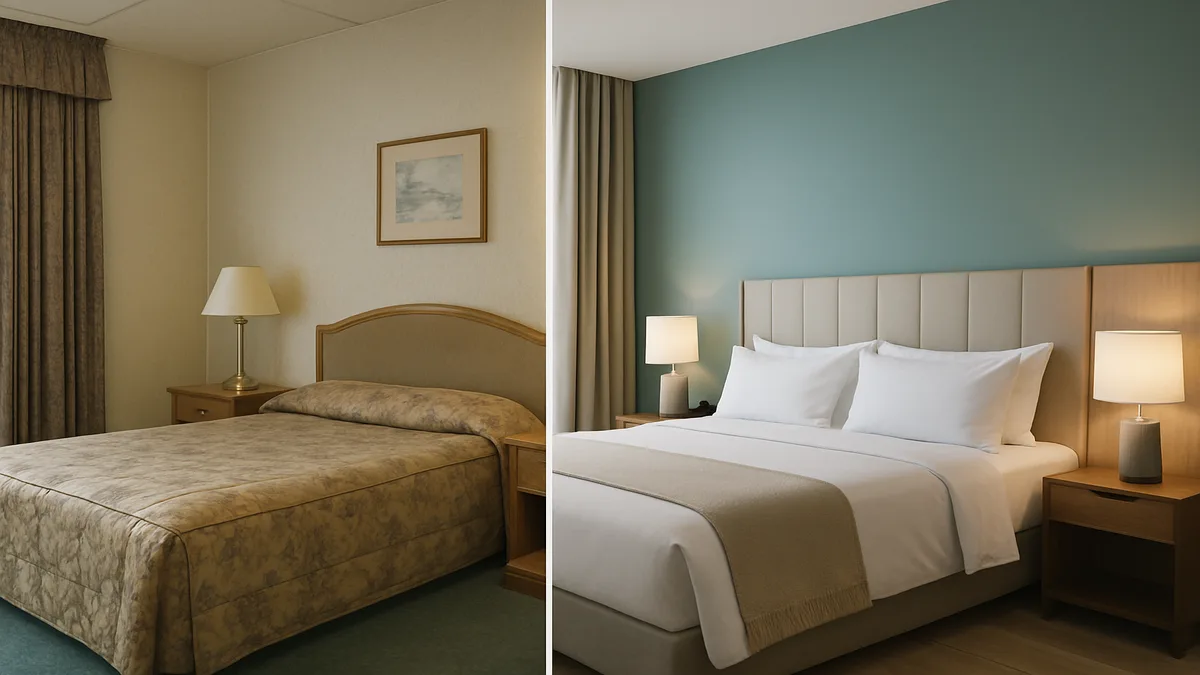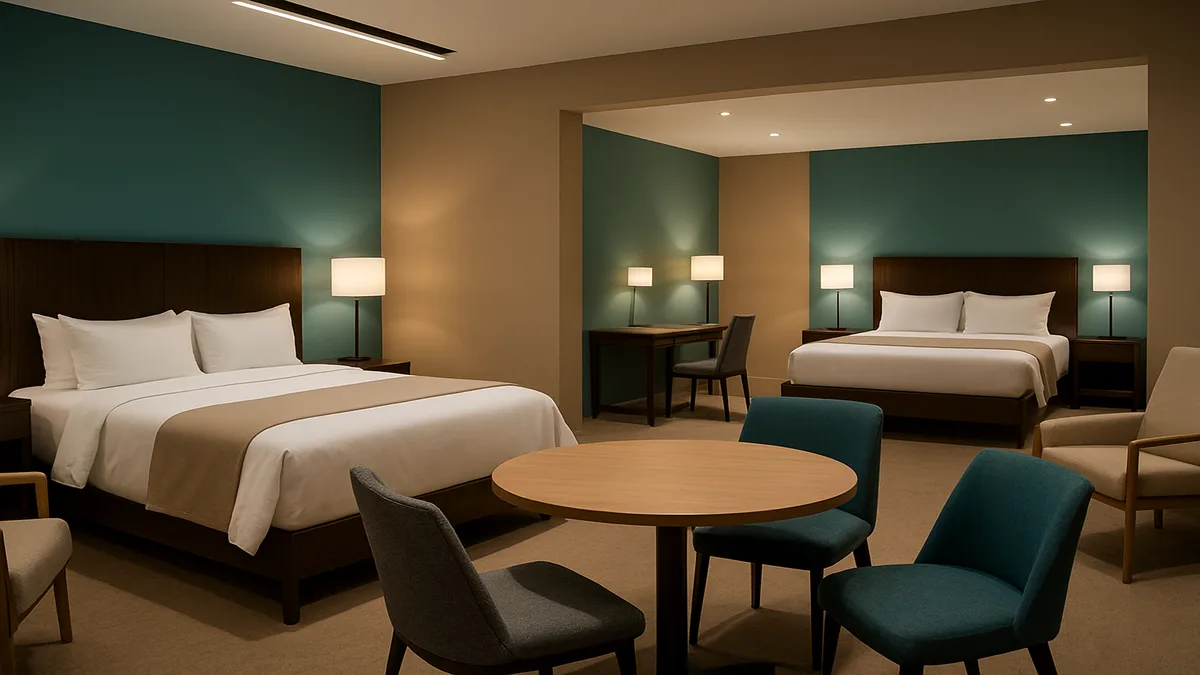
The global hotel FF&E (Furniture, Fixtures & Equipment) market is valued at $55-59 billion, growing at a 6.9-7.3% compound annual growth rate, and projected to reach approximately $107 billion by 2030 according to Grand View Research. Within this market, furniture represents the largest single category — casegoods, seating, tables, outdoor furnishings, and specialty pieces for lobbies, restaurants, spas, and guest rooms.
For manufacturers considering entry into the hospitality furniture market, or existing producers looking to scale their hotel business, the opportunity is substantial and growing on multiple fronts. The global hotel construction pipeline hit an all-time record in Q4 2024 with 15,820 projects representing 2,438,189 rooms. The U.S. pipeline alone reached an all-time high of 6,378 projects. The Middle East hit a record 659 projects with 163,816 rooms. Asia-Pacific reached a record 1,977 projects in Q4 2023, led by India (514 projects), Vietnam (253 projects), Indonesia (208 projects), and Thailand (155 projects).
On top of new construction, the Property Improvement Plan (PIP) backlog is estimated at $12-15 billion needing completion, with record conversion and renovation activity (2,028 projects representing 303,330 rooms in Q4 2023). Guest room renovation costs range from $8,000-25,000 per room, with PIP costs running 30%+ above pre-COVID levels.
But hotel furniture is not residential furniture with a commercial markup. The product requirements, quality standards, pricing dynamics, sales processes, and logistics are fundamentally different from consumer furniture manufacturing or retail. If you are exploring the hospitality supply market for the first time, our guide to becoming a hotel supplier covers vendor portals, GPO applications, and the full approval roadmap. This guide covers every dimension that manufacturers, factories, and wholesale distributors need to understand to successfully enter or scale in the hospitality furniture market.
Product Categories: What Hotels Buy
Hotel furniture procurement is organized into distinct categories, each with specific requirements, price points, buyer expectations, and procurement cycles. Understanding these categories is essential for positioning your products correctly and targeting the right buyer segments. For a broader overview of how furniture fits into the full FF&E landscape, see our complete guide to hotel FF&E.
Casegoods
Casegoods are the hard furniture in a hotel guest room: headboards, nightstands (typically 2 per room), dressers or media consoles, desks or work surfaces, TV consoles or wall-mounted media units, minibars or minibar cabinets, luggage racks, and wardrobe or closet systems. This is typically the largest furniture line item in a guest room renovation, accounting for 40-50% of the room’s total furniture budget.
Key specifications that procurement teams evaluate:
- Construction: Solid wood, engineered wood (MDF, particleboard, plywood), or metal frames with veneer, laminate, thermofoil, or lacquer finishes. Engineered wood with high-pressure laminate is the standard for midscale and upper midscale. Solid wood with veneer or lacquer finishes is specified for upscale and luxury.
- Durability requirement: Minimum 10-year lifecycle in a hotel environment, which subjects furniture to dramatically higher wear than residential use. A hotel desk experiences more use in 1 year than a home office desk experiences in 5.
- Finish durability: Must withstand daily cleaning with commercial-grade chemicals (including bleach-based sanitizers) without degradation, discoloration, or delamination. Post-pandemic cleaning protocols have made this requirement even more stringent.
- Hardware standards: Drawer slides rated for minimum 50,000 cycles (75,000+ for upscale), soft-close mechanisms, concealed hinges rated for 100,000+ cycles. Hotels replace hardware more often than casework — design for easy hardware replacement.
- Brand standards: Major hotel chains publish detailed casegood specifications including exact dimensions, drawer box construction methods, acceptable hardware finishes, material grades, edge profile details, and electrical integration requirements for USB ports and power outlets.
Price range: $2,000-8,000 per guest room for a complete casegood package (headboard, two nightstands, desk, dresser/media console, TV unit/mount, minibar cabinet, luggage rack) depending on quality tier, materials, and degree of customization. Luxury custom casegoods can exceed $15,000-25,000 per room for suite-level specifications.
Seating
Hotel seating spans multiple sub-categories, each with different specifications and procurement dynamics:
Guest room seating: Desk chairs, lounge chairs, love seats or small sofas, ottomans, and window seat cushions. Typically purchased as part of the guest room furniture package.
Lobby and public area seating: Sofas, lounge chairs, accent chairs, benches, and modular seating systems. These are the most design-intensive pieces in a hotel, often custom-designed or specified by the project’s interior designer.
Restaurant and bar seating: Dining chairs, bar stools, banquette seating, booth systems, and counter seating. Must meet food service hygiene requirements in addition to hospitality durability standards.
Conference and meeting room seating: Task chairs, stacking chairs, nesting chairs, and theater-style seating. Must balance comfort, durability, flexibility (stacking and storage), and aesthetic consistency with the hotel’s design language.
Outdoor lounge and dining seating: Pool loungers, dining chairs, bar stools, lounge chairs, and daybeds designed for weather exposure, UV resistance, and high-traffic hospitality use.
Key specifications across all seating categories:
- Upholstery: Commercial-grade fabrics rated at 50,000+ double rubs (Wyzenbeek abrasion test method) or 30,000+ cycles (Martindale method) as the minimum baseline. Midscale properties typically specify 50,000-75,000 double rubs. Luxury properties routinely specify 100,000+ double rubs. Stain resistance treatment (Crypton, Nanotex, or equivalent) is increasingly standard.
- Foam: High-resilience foam at 2.0+ pound per cubic foot density minimum for hospitality seating. Standard furniture foam (1.5 lb/ft3) will compress noticeably within 6-12 months of hotel use. Specify HR foam and provide density documentation in your proposals.
- Frame construction: Hardwood frames (maple, birch, beech) with corner-blocked, glued, and doweled joints. Hotels reject furniture built with staple-only or butt-joint construction, which fails under commercial use cycles. Metal frames are acceptable for certain design aesthetics and outdoor applications.
- Fire retardancy: Upholstered seating must meet applicable fire codes based on the project’s jurisdiction:
- California TB 117-2013 (smolder resistance) for U.S. projects — this is the de facto national standard because California market access requires it
- BS 5852 / EN 1021-1/2 (ignition resistance from cigarette and match flame) for UK and European projects
- NFPA 701 for fabrics used in drapery and decorative applications
- Gulf states and Asia-Pacific markets generally reference either the U.S. or UK standard, often specifying the stricter of the two
Price range: $300-2,000 per piece depending on category, specification level, materials, and customization. Lobby statement pieces can reach $5,000-15,000 for custom designs.
Outdoor Furniture
Pools, terraces, rooftop bars, beach areas, and garden spaces require furniture engineered specifically for sustained weather exposure, UV radiation, extreme temperatures, and high-traffic hospitality use. Outdoor furniture is its own specialty category because the material science and construction methods differ fundamentally from indoor furniture.
Key specifications:
- Materials: Powder-coated aluminum (the most common frame material for hotel outdoor furniture due to corrosion resistance and weight), grade-A plantation teak (for luxury properties willing to maintain it), synthetic wicker made from high-density polyethylene (HDPE) or polypropylene (not PVC, which degrades in UV), marine-grade 316 stainless steel for coastal and high-moisture environments
- UV resistance: Minimum 3 years of color stability under direct sun exposure, verified through ASTM G154 accelerated weathering testing or equivalent. Properties in the Middle East, Southeast Asia, and Caribbean require premium UV specifications due to extreme solar exposure.
- Fabric: Solution-dyed acrylic (Sunbrella or equivalent) for all cushions, parasols, and umbrellas. Solution-dyed fabrics maintain color because the pigment is embedded in the fiber during manufacturing, not applied as a surface treatment that fades.
- Stackability and storage: Hotels need outdoor furniture that can be stacked efficiently for storage during off-seasons, inclement weather, and event reconfigurations. A pool chair that does not stack is a liability for operations teams. Design stackability and storage efficiency into every outdoor piece.
- Quick-dry foam: Outdoor cushions must use open-cell foam or mesh suspension systems that drain and dry rapidly. Closed-cell foam traps water and creates mold.
Price range: $200-3,000 per piece depending on material, size, and specification level.
Specialty and Public Area Furniture
Lobbies, restaurants, spas, fitness centers, meeting rooms, business centers, and corridors require furniture that balances aesthetics, durability, brand identity, and functional requirements specific to each space type.
This category is where hotels invest most heavily in design differentiation. Lobby furniture is the first physical touchpoint for guests and sets the tone for the entire property experience. Hotels use it to establish their brand identity, create Instagram-worthy moments, and differentiate from competitors. For suppliers, specialty and public area furniture commands the highest margins but requires the strongest design capabilities and the ability to execute custom work reliably.
Quality Standards: What You Must Meet
Hotel furniture buyers evaluate quality through established industry standards. Suppliers who cannot demonstrate compliance with relevant standards are screened out before pricing is discussed. Quality certification is not a differentiator — it is table stakes.
BIFMA Standards (Business and Institutional Furniture Manufacturers Association)
BIFMA is the primary quality standard body for commercial furniture in North America. Hotels reference BIFMA standards in procurement specifications, and compliance is effectively mandatory for any supplier selling to U.S. or Canadian hotel chains or to international brands that reference North American standards.
| BIFMA Standard | Applies To | Key Tests Included |
|---|---|---|
| BIFMA X5.1 | Office and desk chairs | Stability testing, structural durability, seat impact, backrest fatigue cycling (100,000+ cycles), arm load, caster/wheel testing |
| BIFMA X5.4 | Lounge and side chairs | Arm strength, back durability, seat drop impact, stability under load, structural integrity after cycling |
| BIFMA X5.5 | Desks, tables, and work surfaces | Stability under eccentric loading, structural load capacity, surface impact durability, drop resistance |
| BIFMA X5.6 | Panel systems and casegoods | Structural load bearing, drawer cycle testing (minimum 50,000 open/close cycles), hinge durability, shelf deflection |
| BIFMA X5.9 | Storage units | Tip stability (anti-tip testing), shelf load capacity, drawer pull strength, door cycle durability |
| BIFMA e3 LEVEL | All furniture categories (sustainability) | Environmental criteria including material sourcing, energy use, emissions, recyclability, and social responsibility |
Testing specifics that procurement teams reference: BIFMA X5.1 desk chair testing includes 100,000 seat drop cycles at specified loads, 120,000 backrest fatigue cycles, and 75,000 arm load cycles. BIFMA X5.6 casegood testing includes 50,000 drawer open/close cycles and hinge durability testing. Hotel procurement teams know these specific numbers and will ask for test reports citing them.
Third-party testing through accredited labs costs $2,000-8,000 per product line, depending on the number of standards tested and the complexity of the product. The investment pays for itself immediately through access to hotel procurement opportunities that are closed to untested suppliers.
European EN Standards
For hotels in Europe, the Middle East, and significant parts of Asia-Pacific, EN (European Norm) standards apply in addition to or instead of BIFMA.
| EN Standard | Applies To | Key Focus |
|---|---|---|
| EN 1021-1/2 | Upholstered furniture | Ignitability by smoldering cigarette (Part 1) and match flame (Part 2) |
| EN 1728 | Seating | Strength, durability, and safety under static and dynamic loading |
| EN 15372 | Tables | Strength, durability, stability, and safety requirements for non-domestic tables |
| EN 527 | Office and work furniture | Dimensional requirements, safety, and mechanical performance |
| EN 14073 | Storage furniture | Strength, durability, safety, and stability for non-domestic storage |
| EN 16139 | Contract seating | Strength, durability, and safety specifically for non-domestic (commercial) seating — the most relevant EN standard for hotel furniture |
EN 16139 is particularly important because it specifically addresses contract (commercial) seating, making it the European equivalent of BIFMA for hotel furniture applications.
Fire Safety Compliance
Fire safety compliance is non-negotiable in hotel furniture and varies by jurisdiction. Hotels operating in multiple countries will typically specify the strictest applicable standard to simplify their procurement process.
- California TB 117-2013: Smolder resistance standard for upholstered furniture. Required for any furniture sold in California and adopted as the de facto national U.S. standard.
- BS 5852 / EN 1021-1/2: British and European ignition resistance testing using cigarette and match flame sources. Required for UK and EU hotel markets and widely referenced globally.
- NFPA 701: Flame propagation standard for fabrics used in hotels including draperies, bed covers, decorative throws, and decorative textiles.
- UK Building Safety Act 2022: Expanded fire safety regulations that brought hotels over 18 meters within scope of the Combustible Materials Ban, requiring external wall materials to meet A2-s1, d0 or better performance for new builds and major refurbishments.
Hotels operating in multiple jurisdictions will specify the strictest applicable standard. If you sell globally, test to both California TB 117-2013 and BS 5852 / EN 1021-1/2 to maximize market access.
Sustainability Certifications for Furniture
Hotel sustainability certifications grew 20% between 2022 and 2023, and major chains have published hard sustainability targets. This makes environmental certifications increasingly required rather than optional for furniture suppliers.
- FSC (Forest Stewardship Council): Chain of custody certification for all wood products. Required for furniture going into LEED-certified hotel properties and increasingly specified as a standard requirement by major chains including Marriott (net-zero by 2050, SBTi-verified), Hilton, and IHG.
- BIFMA e3 LEVEL: The leading multi-attribute sustainability standard specifically for furniture. Evaluates materials, energy and atmosphere, human and ecosystem health, and social responsibility. Available at Silver, Gold, and Platinum levels.
- GREENGUARD / GREENGUARD Gold: Low chemical emissions certification for indoor air quality. Required for LEED credit compliance and increasingly specified for WELL Building Standard-certified hotel properties.
- Cradle to Cradle Certified: Circular product design certification evaluating material health, material reutilization, renewable energy, water stewardship, and social fairness. A premium certification that significantly differentiates suppliers in competitive RFPs for design-forward hotel projects.
Sourcing vs. Manufacturing: The Strategic Decision
Hotel furniture companies generally operate under one of three business models. The right choice depends on your capital, volume targets, margin requirements, and competitive positioning.
Model 1: Fully Integrated Manufacturer
You own the production facility, control raw material sourcing, and manage the full manufacturing process from timber or raw material through finished and packaged product.
Advantages: Maximum quality control across every production step, ability to build a brand premium, full customization capabilities, intellectual property protection, higher margins at scale, complete control over production scheduling and prioritization.
Challenges: High capital requirements ($500,000-5,000,000+ for a production facility capable of serving hotel contract volumes), long ramp-up time to operational efficiency, fixed overhead costs regardless of order volume, need for skilled workforce (upholsterers, finishers, CNC operators, quality inspectors).
Best for: Suppliers targeting premium and luxury hotel segments where quality differentiation and customization capability command margin premiums that justify the capital investment. Also appropriate for manufacturers in low-labor-cost markets who can achieve cost leadership through vertical integration.
Model 2: Design and Source (Asset-Light)
You design products, establish quality specifications, manage brand and customer relationships, and source manufacturing from contract factories — typically in China, Vietnam, Malaysia, Indonesia, India, Mexico, or Eastern Europe (Poland, Romania, Turkey).
Advantages: Lower capital requirements, flexibility to scale production capacity up and down based on order volume, access to specialized manufacturing capabilities across multiple factories (one factory for metalwork, another for upholstery, another for casegoods), ability to pivot sourcing in response to tariffs or trade disruptions.
Challenges: Quality control requires robust third-party inspection programs, lead times are longer due to production scheduling at shared factories, less control over production prioritization during peak seasons, intellectual property risk varies by manufacturing country, and communication complexity increases with multiple factory relationships.
Nearshoring trend: 57% of companies reported nearshoring as a key supply chain strategy in 2023. Mexico saw a 17% year-over-year increase in U.S. buyer audits and inspections in Q3 2023, and Vietnam recorded the strongest reshoring-related sales increase globally. The trend is accelerating: 26% of companies globally plan to nearshore in 2025, with 33% in the U.S. alone. For hotel furniture, this means sourcing is shifting closer to end markets — Mexico for the U.S. market, Turkey and Eastern Europe for the EU and Middle East, and Vietnam and India for the Asia-Pacific market.
Best for: Companies with strong design capabilities, established brand positioning, and the ability to manage multi-factory quality assurance programs. This is the most common operating model for mid-market hotel furniture companies.
Model 3: Trading Company / Distributor
You aggregate products from multiple manufacturers and sell to hotels as a one-stop-shop, providing breadth of selection, consolidated logistics, and local service.
Advantages: Minimal capital investment in manufacturing, wide product range across multiple categories, fast market entry, low operational risk.
Challenges: Lowest margins of any model (typically 15-25% versus 30-50% for manufacturers), limited product differentiation, vulnerability to disintermediation as hotels increasingly go direct to factories, difficulty building brand equity because you are selling other companies’ products.
Best for: Regional distributors with deep, established hotel relationships who can leverage service quality, logistics efficiency, local market knowledge, consolidated billing, and problem-solving as their competitive differentiation. The value proposition is not the furniture itself — it is the ease of doing business.
Stop chasing hotels manually. InnLead.ai’s 12 AI agents scan renovation signals, identify procurement contacts, and book meetings with hotel buyers — automatically. Get Early Access
Shipping Logistics: Container Optimization and Delivery
Shipping is a make-or-break factor in hotel furniture profitability. Furniture is bulky, often fragile, and expensive to transport over long distances. The difference between a well-optimized container load and a poorly packed one can swing project margins by 5-10 percentage points — the difference between a profitable project and a break-even one.
Container Optimization
| Container Type | Internal Dimensions (LxWxH) | Usable Volume (CBM) | Typical Hotel Furniture Load |
|---|---|---|---|
| 20’ Standard | 5.9m x 2.35m x 2.39m | ~33 CBM | 15-25 guest room casegood sets |
| 40’ Standard | 12.03m x 2.35m x 2.39m | ~67 CBM | 30-50 guest room casegood sets |
| 40’ High Cube | 12.03m x 2.35m x 2.69m | ~76 CBM | 35-55 guest room casegood sets (preferred for hotel furniture due to 30cm extra height) |
The 40’ High Cube is the standard container for hotel furniture shipments because the additional 30cm of internal height accommodates headboards, tall dresser units, and more efficient stacking of casegood components.
Optimization tactics that protect margins:
- Design for knockdown (KD) assembly wherever functionally and aesthetically acceptable. A KD headboard ships at 30-50% of the volume of an assembled headboard. A KD desk ships at 40-60% of assembled volume. Hotels have maintenance teams capable of simple assembly, and many procurement contracts expect KD delivery.
- Nest seating by designing chairs and stools that stack or nest to minimize void space. Chairs that stack 4-high in shipping cartons dramatically improve container utilization.
- Stack table bases separately from tops and pad appropriately to prevent finish damage during transit.
- Use container load planning software (CargoWiz, EasyCargo, or equivalent) to optimize packing sequences and maximize cubic utilization before committing to container quantities.
- Coordinate production schedules to fill containers completely rather than shipping partial loads. A half-empty container doubles your per-unit freight cost.
- Target a containerization rate of 85%+ (actual volume used divided by total container volume). Below 80% signals optimization opportunities.
Supply Chain Timeline for Hotel Furniture
For imported furniture (factory to hotel site), plan with these realistic timelines:
| Phase | Duration | Key Considerations |
|---|---|---|
| Design approval and sampling | 4-8 weeks | Includes revision rounds and final client approval sign-off. Custom pieces may require 2-3 sample iterations. |
| Raw material procurement | 2-4 weeks | Longer for specialty materials, custom fabrics, and imported hardware. Order fabric early — it is often the longest lead-time component. |
| Production | 6-12 weeks | Varies based on order volume, factory capacity, complexity, and finish requirements. Custom finishing (multi-step lacquer, hand-applied techniques) adds 2-4 weeks. |
| Quality inspection (pre-shipment) | 1-2 weeks | Third-party inspection (SGS, Bureau Veritas, Intertek) strongly recommended for orders over $50K. Inspect at 80% production completion for early defect detection. |
| Ocean freight (Asia to US/EU) | 3-5 weeks | Asia to US West Coast: 2-3 weeks. Asia to US East Coast: 4-5 weeks. Asia to EU: 4-5 weeks. Add 1-2 weeks for Middle East or other destinations. |
| Customs clearance and inland delivery | 1-2 weeks | Factor in potential port congestion. Arrange last-mile delivery with a carrier experienced in hotel furniture (white glove, inside delivery, debris removal). |
| Total lead time | 17-33 weeks | Plan for 20-24 weeks as your standard communication to hotel clients. Under-promising and over-delivering protects relationships. |
Hotel renovation schedules are rigid. Hotels set room-out-of-service dates, renovation timelines, and room-back-in-service dates that directly affect revenue. A supplier who delivers late can face contractual penalty clauses, emergency re-sourcing at their expense, and — worst of all — permanent disqualification from future projects with that hotel group. Build realistic buffer into your timelines and communicate proactively and early if any delay is anticipated.
Shipping cost context: Container and truckload costs reached 5-6 times pre-pandemic levels in 2021-2022, creating severe margin pressure for furniture importers. By 2023, port backlogs had cleared, sea freight charges were declining, and container availability normalized. However, timber prices increased 35% between 2022 and 2024, keeping raw material input costs elevated even as logistics costs moderated. Build commodity price volatility into your pricing models.
Pricing: Cost-Plus vs. Market-Based
Hotel furniture pricing requires a clear and defensible strategy. The two dominant approaches serve different market positions and customer segments.
Cost-Plus Pricing
Formula: Raw materials + Direct labor + Manufacturing overhead + Shipping and logistics + Target margin (15-30%) = Selling price
When to use: New market entry where you lack brand recognition, standard (non-custom) product lines sold competitively, and situations where transparency builds trust with procurement teams who will benchmark your pricing against competitors. Cost-plus works well when you can demonstrate that your cost structure is efficient, because sophisticated procurement teams will verify your pricing against industry benchmarks and their own historical data.
Risks: Limits your upside on differentiated or custom products. Exposes your margin structure to buyers who may push for compression. Can create a race to the bottom if your competitors have lower cost bases (offshore manufacturing, lower labor costs, established raw material contracts).
Market-Based Pricing
Formula: Market price for your quality tier, brand positioning, design capability, and service level, adjusted for competitive dynamics and the specific opportunity.
When to use: Differentiated products, custom design capabilities, established brand reputation, projects where you add value beyond the physical product (design services, project management, installation coordination, warranty and replacement programs).
Example: A standard midscale casegood set might sell for $3,000 using cost-plus pricing. The same set with custom finishes specified by the project designer, your firm’s project management from design through installation, and a 10-year structural warranty might sell for $5,000-7,000 using market-based pricing — because the buyer is purchasing a complete solution and risk mitigation, not just furniture.
Pricing Benchmarks by Hotel Tier
| Hotel Segment | Guest Room Furniture Budget (per room) | Quality Specification Level | Typical Procurement Process |
|---|---|---|---|
| Luxury | $8,000-25,000+ | Custom design, premium materials, artisan finishing, bespoke details | Designer-specified; limited competitive bid among approved suppliers |
| Upper Upscale | $5,000-12,000 | High-quality standard with brand customization and select premium materials | Brand standard specification with approved vendor list; design input from brand team |
| Upscale | $3,500-7,000 | Brand-standard compliant, commercial grade, some customization | Competitive bid from brand-approved suppliers; price and quality both significant |
| Upper Midscale | $2,500-5,000 | Commercial grade, cost-efficient, limited customization | Value-oriented competitive bid; price carries heavier weight |
| Midscale / Economy | $1,500-3,500 | Budget commercial, conversion-ready, minimal customization | Price-driven, high-volume purchasing; efficiency and lead time critical |
Hospitality vendors have reported price increases of 90-300% on various products during the post-pandemic period, and the market has demonstrated willingness to absorb higher pricing when supply is constrained. Currently, with raw material costs stabilizing but timber prices still 35% above 2022 levels, pricing in the upper ranges of these benchmarks is achievable for suppliers who justify the value.
Getting Samples into Hotel Procurement Offices
The most overlooked step in the hotel furniture sales process is sample placement. Procurement teams and designers evaluate furniture physically — they assess finish quality with their eyes, construction detail with their hands, upholstery feel against their skin, and durability through years of experience evaluating products. A beautiful catalog photograph or a 3D rendering does not close a deal. A well-made sample in the right procurement office or design studio does.
Sample Strategy
What to produce as your sample set: A curated collection that represents your quality range, customization capability, and design point of view. For casegoods, this might include a nightstand (shows finish, edge detail, drawer mechanism, and hardware), a desktop section with integrated power/USB (shows surface quality and technology integration), and a headboard panel with fabric or upholstered detail. For seating, a single chair in your most common hotel-grade upholstery with visible construction quality. For outdoor, a representative piece in your primary material.
How to get samples in front of decision-makers:
-
Trade shows. HD Expo (Las Vegas, May), BDNY (New York, November), The Hotel Show Dubai (May), and regional equivalents are where samples get their first in-person viewing. HD Expo alone hosts 900+ exhibiting companies displaying products across every furniture category with 600 exhibitors representing 25+ industry sectors by 2025. The tactile, in-person nature of these shows is irreplaceable for furniture.
-
Designer and specifier outreach. Hotel interior designers and architectural firms are the gatekeepers for furniture selection on many projects, particularly luxury and upper upscale. Identify firms working on active hotel projects (public permit data, design publication features, LinkedIn announcements), and send targeted sample packages with spec sheets to their studios.
-
Direct procurement outreach. When you identify a hotel undergoing renovation through public permit filings, brand conversion announcements (Marriott’s Four Points Flex, Hilton’s Spark, IHG’s Garner are all creating conversion procurement opportunities), or PIP notifications, send a targeted sample with a detailed specification sheet to the property’s procurement contact or the management company’s VP of Procurement.
-
Showroom placement. Maintain a showroom presence in key design and procurement hubs. High Point (North Carolina) is the U.S. furniture market center. The Design and Decoration (D&D) Building in New York serves the East Coast design community. Dubai Design District (d3) and Dubai’s Al Quoz industrial-creative area serve the Middle East market.
-
Mock-up rooms. For large projects (100+ rooms), offer to furnish a complete mock-up guest room at the hotel site or at your showroom for the ownership team, management company, and brand representatives to evaluate. This is standard practice for luxury projects and increasingly common for upper upscale. The investment in a mock-up room ($5,000-15,000 including furniture, shipping, and installation) is justified by the contract value at stake (often $500,000-5,000,000+).
Sample cost management: Samples are expensive to produce and ship, particularly for furniture. Budget $1,000-5,000 per sample set plus shipping costs. Track which samples lead to RFP invitations, shortlist inclusion, and project wins to calculate your sample-to-conversion rate. A healthy rate is 10-20% of samples leading to RFP opportunities and 3-5% leading to closed projects.
The Full Procurement Cycle for Hotel Furniture
Understanding the complete timeline helps you engage at the right moment and with the right stakeholders at each phase.
| Phase | Timing (before opening/renovation) | What Happens | Your Supplier Action |
|---|---|---|---|
| Planning | 12-24 months | Owner and brand agree on PIP scope, budget, design direction, and timeline | Build relationships with the owner, operator, and brand development team. Be visible and credible before specifications are written. |
| Design | 8-14 months | Interior designer selected, design concept developed, preliminary furniture specifications and mood boards created | Present samples and capabilities to the design team. Participate in design development discussions. Show what is possible within budget. |
| Specification | 6-10 months | Detailed furniture specifications finalized, material and finish selections made, vendor shortlist created based on capability and relationship | Respond to RFI/RFQ with comprehensive specifications, samples, preliminary pricing, and delivery timeline. Get on the shortlist. |
| Bidding | 4-8 months | Formal RFP issued to 3-5 shortlisted suppliers with detailed scope, specifications, quantities, and delivery requirements | Submit your best comprehensive bid with final pricing, confirmed samples, reference verification, production plan, and delivery schedule. |
| Award and Production | 3-6 months | Contract awarded, deposits paid, production begins per approved samples and specifications | Execute production with quality checkpoints, pre-shipment inspection, progress reporting, and proactive communication of any issues. |
| Delivery and Installation | 0-2 months before opening | Furniture delivered to site, installed per floor plan, punch list items identified and resolved | Manage delivery logistics (often phased by floor), coordinate with the general contractor and FF&E installer, attend punch walk, resolve any deficiency items within agreed timeframes. |
The entire cycle from first supplier contact to completed installation spans 12-24 months for new construction and 6-12 months for renovations. Suppliers who engage early — during the planning or design phase, 12-18 months before the furniture needs to arrive — have a dramatic advantage over those who first appear at the bidding stage when the shortlist is already formed and the specifications already favor incumbents. Understanding how hotels evaluate suppliers using a scoring matrix helps you prepare for every stage of this cycle.
Key Takeaways for Hotel Furniture Manufacturers and Wholesalers
-
The market is large and growing. $55-59 billion today, projected to reach $107 billion by 2030, with record global construction pipelines and a multi-billion-dollar renovation backlog driving demand across every geographic market.
-
Quality standards are non-negotiable. BIFMA compliance for North America, EN standards for Europe and the Middle East, and fire safety certification for every market are the baseline requirements. Invest in third-party testing and lead with compliance documentation in every proposal.
-
Sustainability is becoming mandatory. FSC certification for wood products, GREENGUARD for indoor air quality, BIFMA e3 LEVEL for comprehensive sustainability, and Cradle to Cradle for circular design are increasingly specified by major chains pursuing sustainability targets and by hotels seeking LEED and WELL certification.
-
Shipping optimization directly impacts project profitability. Design for knockdown assembly, maximize container utilization above 85%, build realistic 20-24 week lead times, and use third-party inspection to catch quality issues before they ship.
-
Samples win deals more than catalogs. Get physical product in front of designers, specifiers, and procurement teams through trade shows, direct outreach, showroom placement, and mock-up rooms. Budget $1,000-5,000 per sample set and track your conversion rate.
-
Engage early in the procurement cycle. The planning and design phases, 12-24 months before hotel opening, are where supplier relationships form and product selections crystallize. By the formal bidding stage, the competitive field is largely set and specifications often reflect the capabilities of suppliers who engaged earlier.
-
The renovation wave creates immediate opportunity. The $12-15 billion PIP backlog, record conversion activity (Hilton Spark, IHG Garner, Marriott Four Points Flex), and 30%+ cost inflation on renovation projects create sustained demand for suppliers who can deliver quality product on compressed timelines.
The hotel furniture wholesale market rewards manufacturers who combine product quality, commercial sophistication, and proactive relationship management. Understanding how hotels buy furniture, what standards they require, and how to navigate the 12-24 month procurement cycle is the difference between building a sustainable, growing hospitality furniture business and remaining a residential manufacturer with occasional hotel orders. For a step-by-step playbook on every viable sales channel, see our guide on how to sell products to hotels. And if you need help identifying hotels that are actively sourcing furniture, see how InnLead.ai can help.
Use these related guides to keep moving through the same procurement, sales, or market research thread.
Skip the Manual Work
InnLead.ai's 12 AI agents find hotels buying your products, identify procurement contacts, and book meetings -- automatically.
Get Early Access